
Written by Lorrie Reynolds
Introduction
Have you ever stood at the edge of an agility ring and watched a handler send their dog through an entire sequence while barely moving a foot? Have you ever wondered how they do that, or told yourself that kind of teamwork was out of reach for you and your dog?
I hear that from handlers all the time. Dog agility distance handling looks like magic from the outside. It looks like something reserved for elite competitors with exceptionally talented dogs and years of specialized training. The truth is that it is none of those things.
Distance handling is not a specialty skill layered on top of everything else you have learned. It is a foundation that makes every handler more effective, every dog more confident, and every run more joyful. It is accessible to new handlers and experienced ones, to athletic handlers and those with physical limitations, to fast dogs and dogs who need a little more encouragement to move out.
In this guide we are going to cover everything you need to understand about distance handling, including why every handler needs it, what skills are required to build it, the framework that ties it all together, and how to train it in a way that builds your dog’s confidence rather than eroding it. By the time you finish reading, you will have a clear picture of what distance handling actually is, what it requires, and exactly where to start.
What Is Distance Handling in Dog Agility?
Distance handling in dog agility is the ability of a team to smoothly work together while separated by anywhere from 6 to 60 feet. The agility dog needs to understand the handler’s cues and respond to them, maintain speed, and complete obstacles independently, even when those cues are coming from far away.
When we talk about distance, we aren’t just talking about the number of feet between team members. Forward distance, where the dog continues ahead of the handler, is different from lateral distance, where the handler works parallel to the dog without being close to him. True distance handling encompasses both. It also requires the dog to understand cues to turn away, determine which obstacle to take when two are equally logical choices, maintain criteria while performing independently, and hold their speed throughout the run.
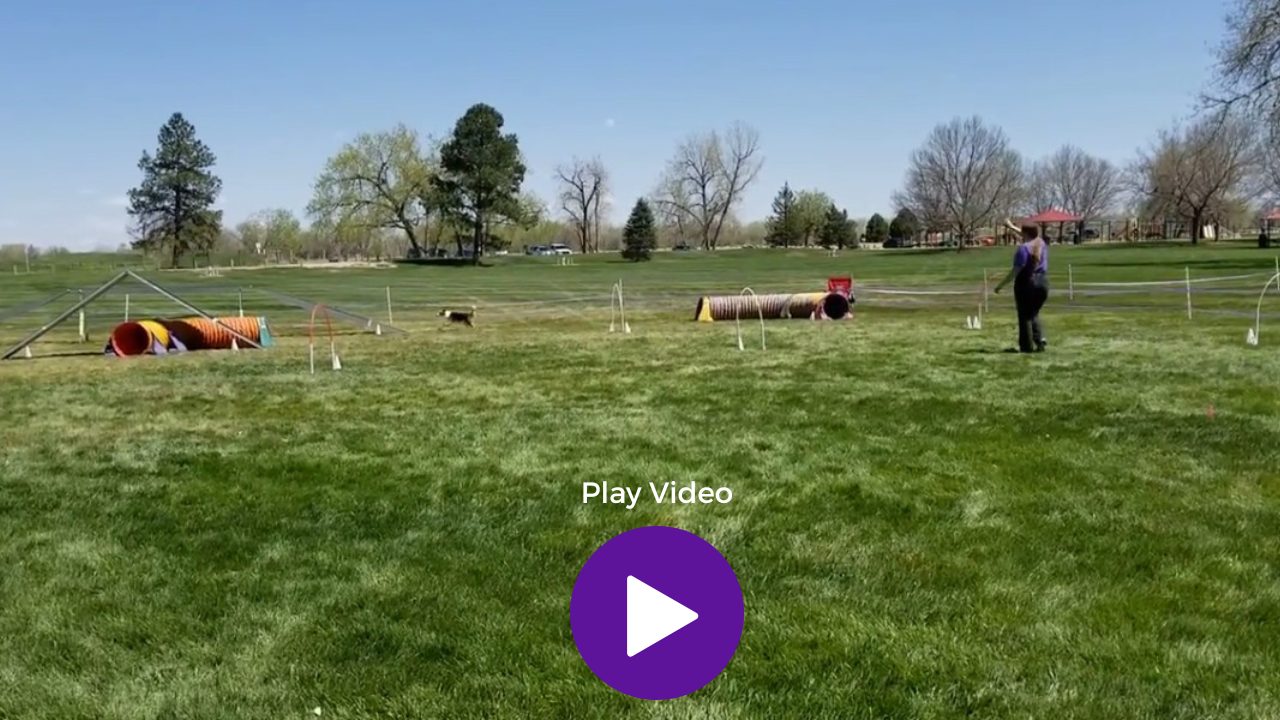
Some of the most impressive distance handlers can stay in a single area and direct their dogs around an entire course with very little movement, using body language, the dog’s understanding of obstacle paths, verbal cues, or some combination of all three. Watching a team “work together apart” is a beautiful and awe-inspiring thing when it all comes together.
Despite how it looks from the sideline, dog agility distance handling isn’t magic, and it isn’t reserved for elite competitors or exceptionally gifted dogs. It’s a skill built deliberately, layer by layer, using a clear communication system and a training approach that gives the dog the independence and confidence to work away from their handler. That’s exactly what this guide is about.
Why Every Handler Needs Distance Skills
Course Design Will Force Your Hand
I tease in my seminars that “Judges are evil” even though I have many friends who are judges and I think they are wonderful people. The reason I joke about it is because judges intentionally design courses to put teams without distance handling skills at a disadvantage.
In general, modern agility courses, especially in venues like UKI, require distance because they are so spread out within a large ring. Unless you are a world-class sprinter, you can’t run from one end of the ring to the other multiple times in the minute or less that an agility run lasts.
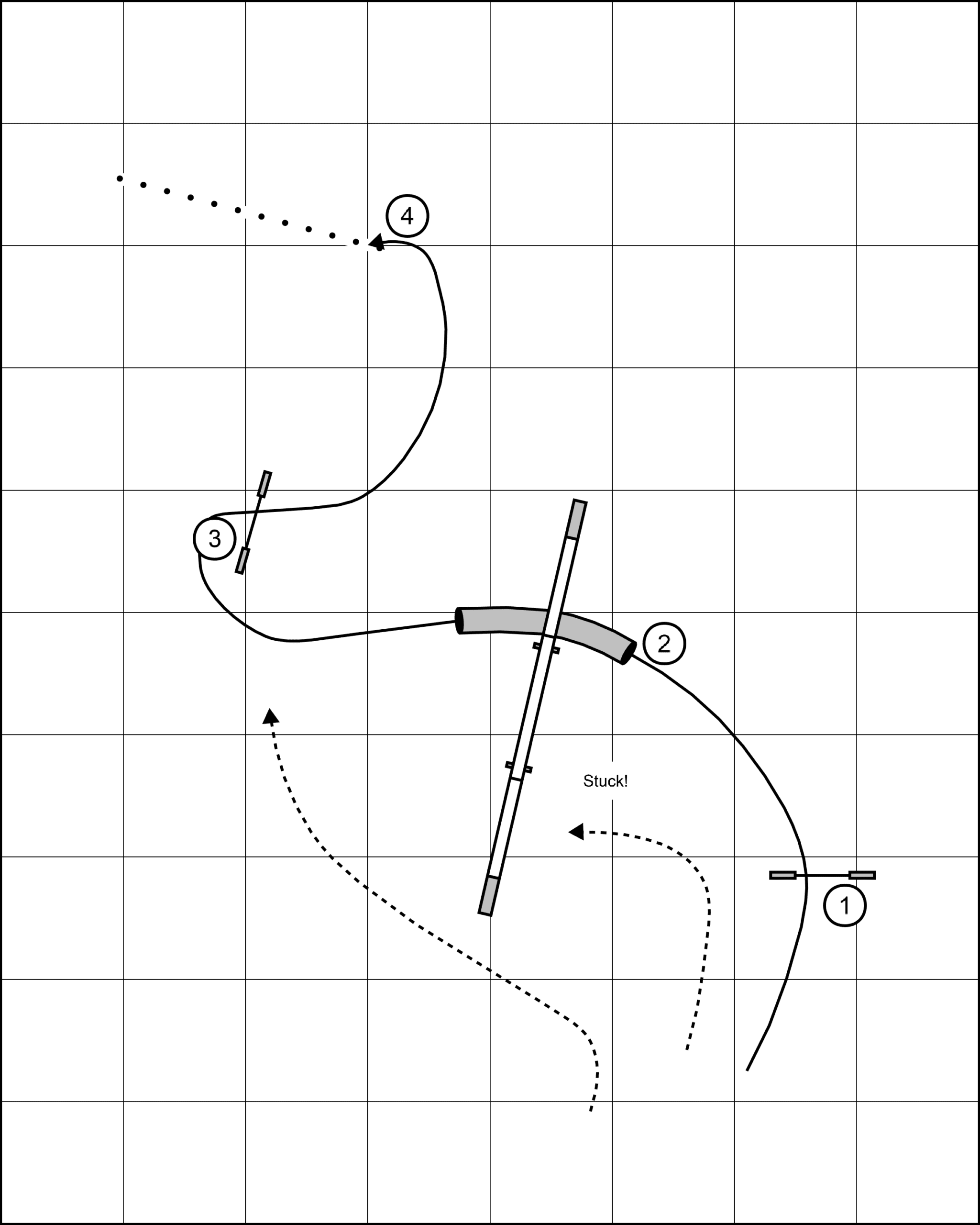
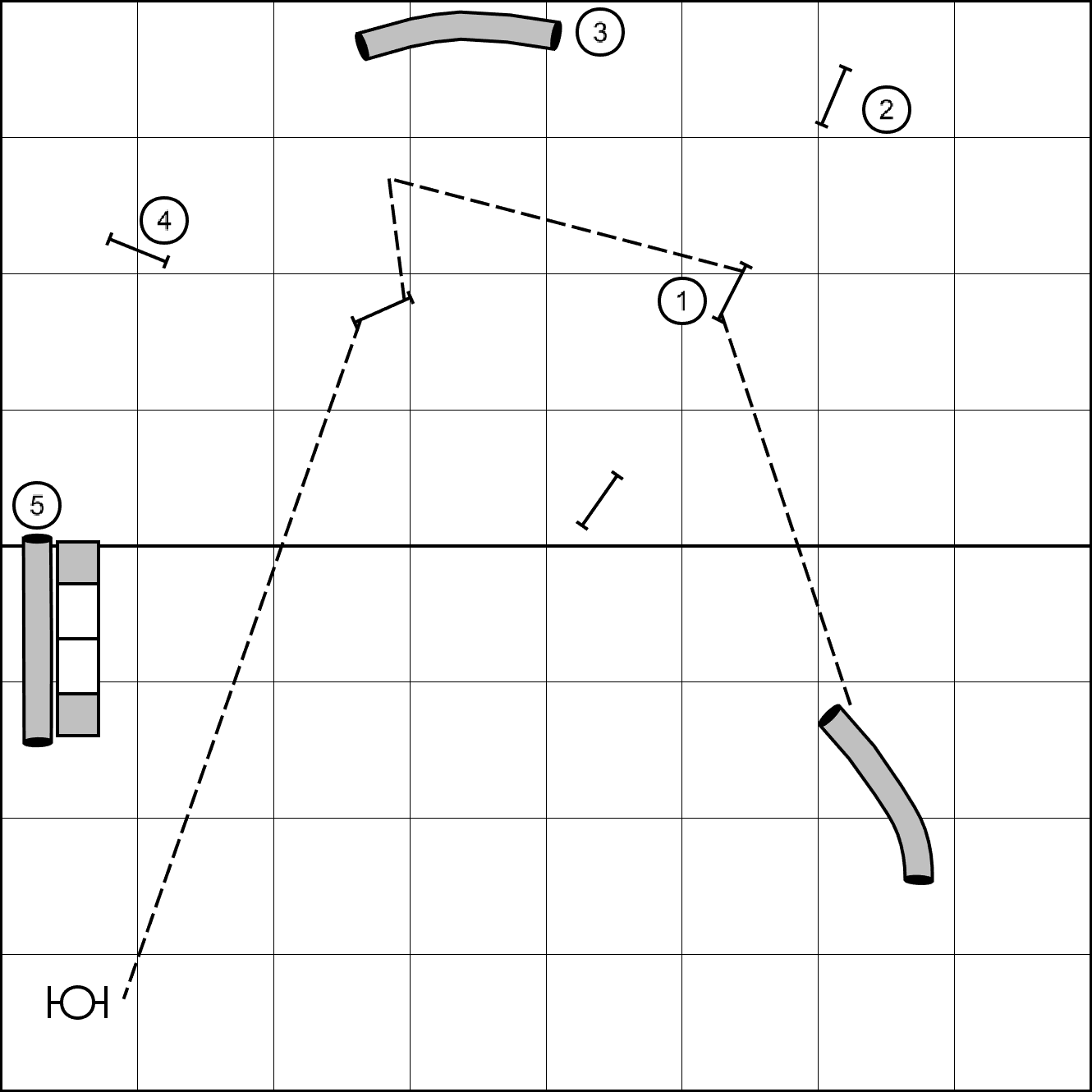
Course design also comes into play on sequences like the example below. If you have to run on the right side of the dog walk to send your dog into the tunnel, you are trapped and can’t get to the left side of the dog walk to direct him to the back side of the next jump. The team that can work at a distance can easily get into position to handle the back side by sending the dog to the tunnel from the left side of the dog walk.
Judges will also design sequences in the distance games that leave teams without good distance skills with fewer options and more risk. When you send your dog to the distance sequence, the line is placed to encourage you to be next to an obstacle that is not part of the sequence. Your position on course can bring the dog in so he takes the off-course obstacle, unless you have the skills as a team to avoid the default behavior and use motion and body language to override the obvious positional cue.
Distance Unlocks More Speed
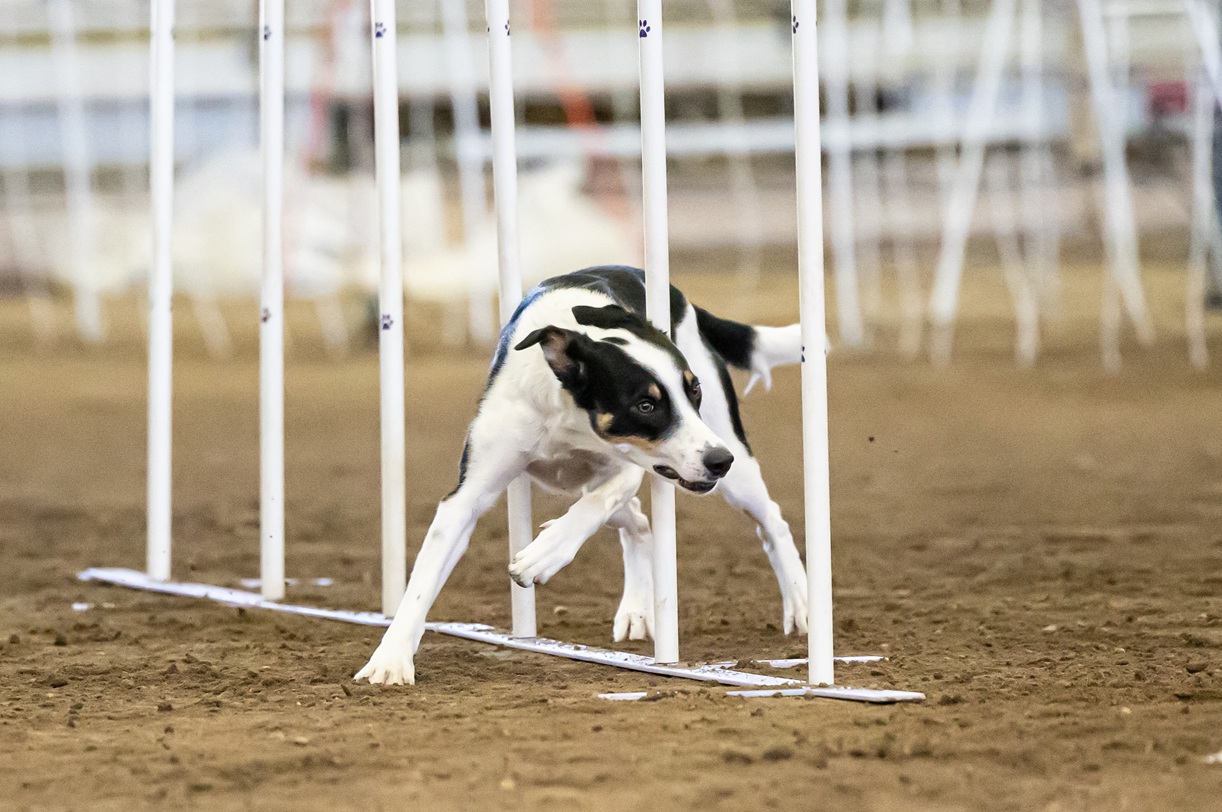
Even if you are a world-class sprinter, people can’t run as fast as dogs when the dogs are moving at full speed. If your dog is staying close to you, he is reducing his speed to match yours.
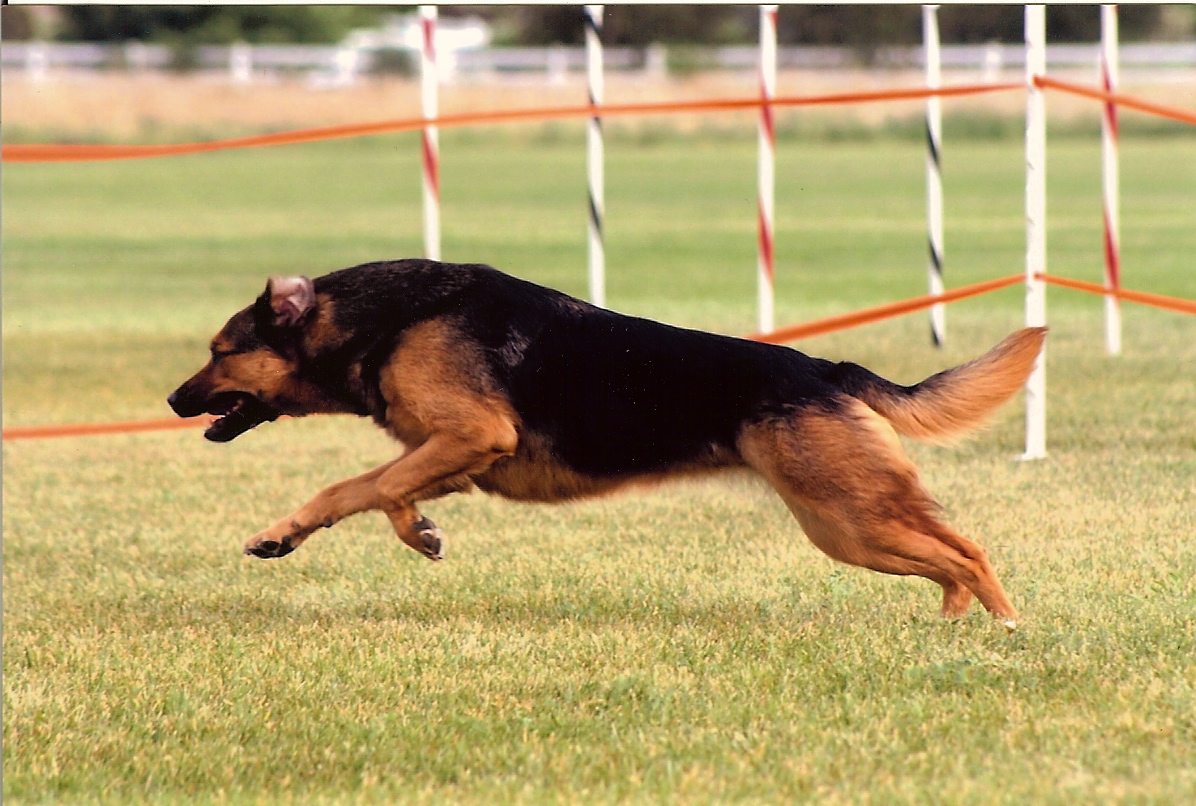
However, a slower handler doesn’t have to equal a slow dog. Distance handling can unlock that speed and let your dog fly. When your dog understands how to perform obstacles independently, can see the path to the next obstacle clearly, and listens to your cues even when you are far away, he can operate at top speed without you holding him back.
The clarity and communication required to help the dog build confidence and learn to work at a distance also encourage speed. The more clearly you can communicate what you want him to do next, the more confidently the dog can perform, and the faster he is able to go.
It Gives You a Strategic Handling Advantage
Being able to send your dog to a straightforward sequence at a distance allows you to move into position to handle the more technical sections of a course and gives you a distinct advantage. For example, if you can send your dog to a pinwheel and trust him to complete it on his own, you can cut across the top of the pinwheel to get into a better handling position for the next sequence.
It Keeps You in the Game When Your Body Has Other Plans
I’ve had many students come to me as a last resort. Injury, illness, or just getting older has changed their physical abilities and they are looking for options that don’t include giving up the game they love.
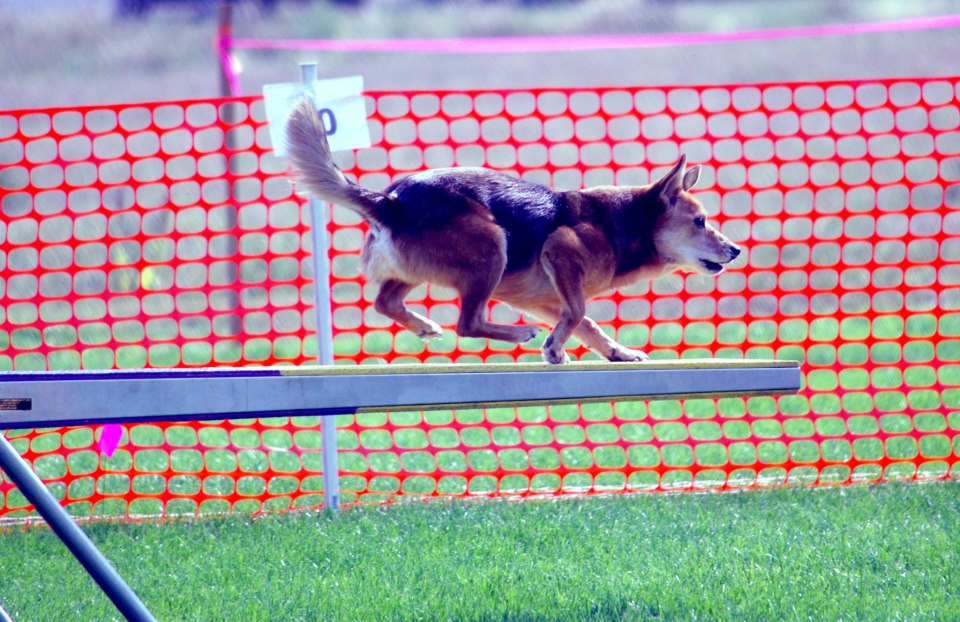
Having a chronic illness and horrible knees myself, I understand how physical limitations can get in the way of doing the things we love. With distance handling, even if your aging knees, your chronic ankle injury, or other limitations keep you from running, you can still participate with your dog and be competitive. I’ve even run my dogs a few times while on crutches!
Distance handling allows handlers to direct their dogs around the course without running a single step. That means that agility no longer belongs to just the young and the fit. With distance handling, you can compete up to the national level and still be successful.
You’ll Finally Succeed at Distance Games and Earn Those Titles
Another common reason people ask me for help is because they have everything they need for their championship title except the gamblers or chances runs. They are having trouble qualifying in the distance games even though their dogs have solid skills in other areas.
Distance handling allows you to stop wasting money on distance games and start qualifying. It also helps you qualify in the other classes. If you are chasing that big accomplishment and Qs in the distance games is the only thing holding you back, it’s time to teach some distance skills.
Less Frustration for You and Your Dog
There are many sources of frustration in agility that distance skills can eliminate for both ends of the leash. If your dog barks at you because he doesn’t know how to move ahead without you right beside him, turns back before the last obstacle, or takes off-courses because your positional cue is overriding everything else, the frustration is real for both of you. When your dog gains the confidence to work away from you, and you gain the skills to guide him clearly from a distance, the whole dynamic shifts. Agility becomes the fun, flowing game it was always supposed to be.
Why Distance Skills Are Worth the Investment
Whether you’re chasing a championship title, managing a physical limitation, trying to unlock your dog’s true speed, or simply tired of leaving shows feeling defeated, distance skills have something to offer you. And here’s the good news: none of this requires a naturally gifted dog or an athletically gifted handler. It requires a system, a plan, and the right foundation. The rest of this guide will give you all three.
What Distance Handling Actually Requires
While a lot of people think dog agility distance handling is magic, it really only requires a specific set of skills, the framework to view them in, and knowledge of how to train the dog. The five essential skills for distance (explained further in 5 Dog Agility Distance Skills That Are Essential for Every Team) are not random. Each one has foundations that the dog starts with, and concepts are built up and interlaced until the dog acquires a complete understanding of how to run with their owner at any distance.
Skill 1: Independent Obstacle Performance
The definition of independent obstacle performance is the dog’s ability to complete any obstacle and maintain the trained criteria regardless of the handler’s position or actions. For a team who works together at a distance, the handler’s job is to get the dog on the right path to the obstacle, and the dog’s job is to complete the obstacle correctly.
Independent obstacle performance allows the handler to send the dog to the obstacle, and as soon as the dog is committed, to move to the next handling position so they are ready to direct the dog through the next portion of the path.
In addition to creating a high value for the obstacles so the dog seeks them out, the dog has to be able to perform in four different situations for each obstacle. I’ve created a mnemonic, CLAWS, to help students remember them. CLAWS is more fully explained in this article: Dog Agility Distance Training: What is the CLAWS Framework?.
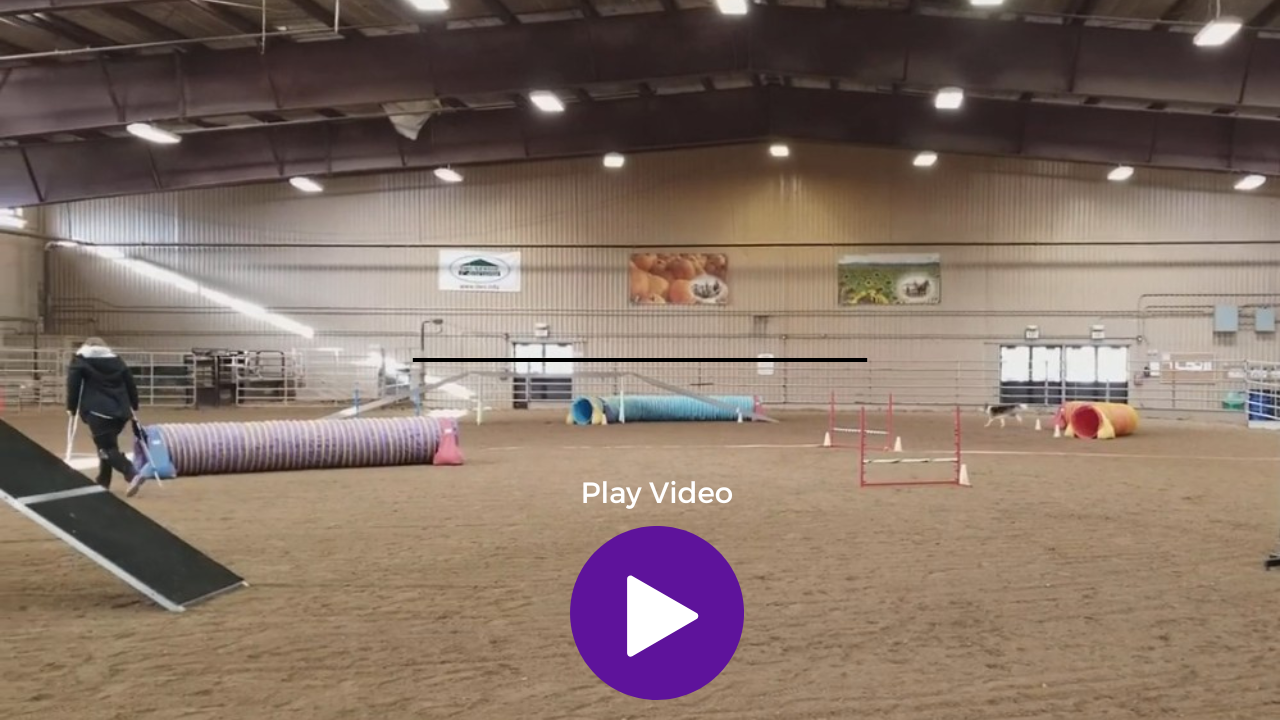
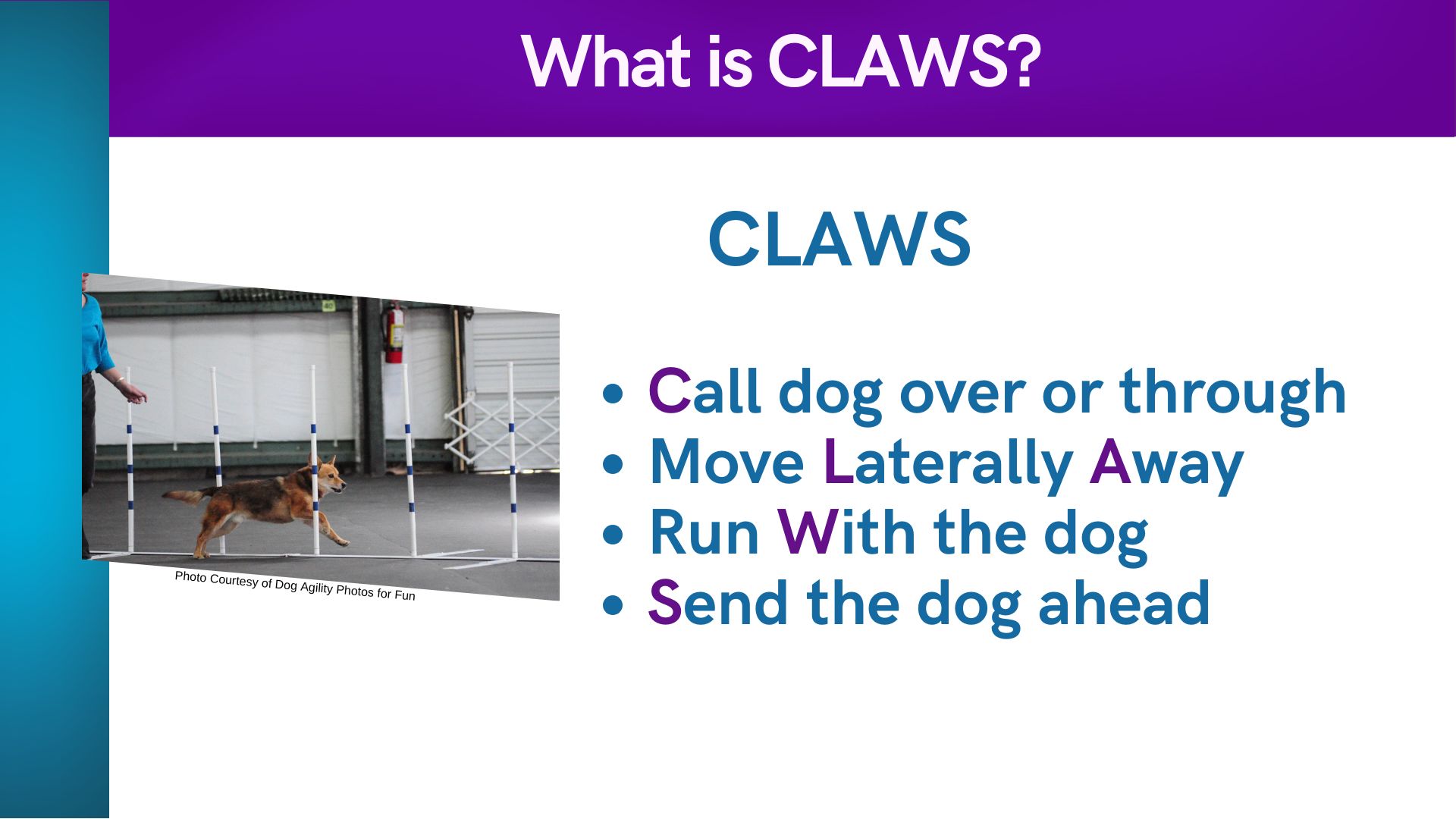
C is for Call. The handler has to be able to call a dog over or through an obstacle when they are ahead of the dog, and the dog needs to maintain their criteria. For example, the handler should be able to call over a jump without the dog knocking the bar, or call over a contact obstacle without the dog missing the contact.
LA is for move Laterally Away. The handler should be able to send the dog to an obstacle and then move laterally away to get into the next handling position. When sending to a contact, the dog should complete the contact and should not come off of the side. The dog should stay in the weave poles to the end instead of popping out when the handler moves laterally.
W is for move With at a parallel distance. The dog should be able to maintain a parallel line at a distance as long as the handler is cueing him to continue on the path. If a handler sends the dog into the weaves, she should be able to run on a line parallel to the weaves, but 30 feet away, and the dog should complete the entire set.
S is for Send. The handler should be able to send the dog over or through the obstacle when they are behind the dog. If the handler sends the dog over the A-Frame or Teeter, for example, the dog should complete the obstacle and maintain criteria without turning back to the handler.
Skill 2: Discriminations
The second essential skill for distance handling is discriminations. Discriminations occur whenever there is a choice between two or more logical obstacles to continue the current path. Discriminations are not just the common contact/tunnel instances we see so frequently on course. They can include two ends of a tunnel, two jumps set close together, or any other combination that allows the dog to choose between two or more paths.
The basis for handling discriminations at a distance is teaching the dog a system of cues that means “out” or “in” so they understand whether to take the outside obstacle or the inside obstacle of a discrimination. Navigating discriminations does not mean teaching the dog obstacle names and being able to call them out on course. That would be useless when the discrimination consisted of two of the same obstacles. It just means teaching them when we want the outside obstacle, and when we want the obstacle that is closer to us.
Skill 3: Directionals
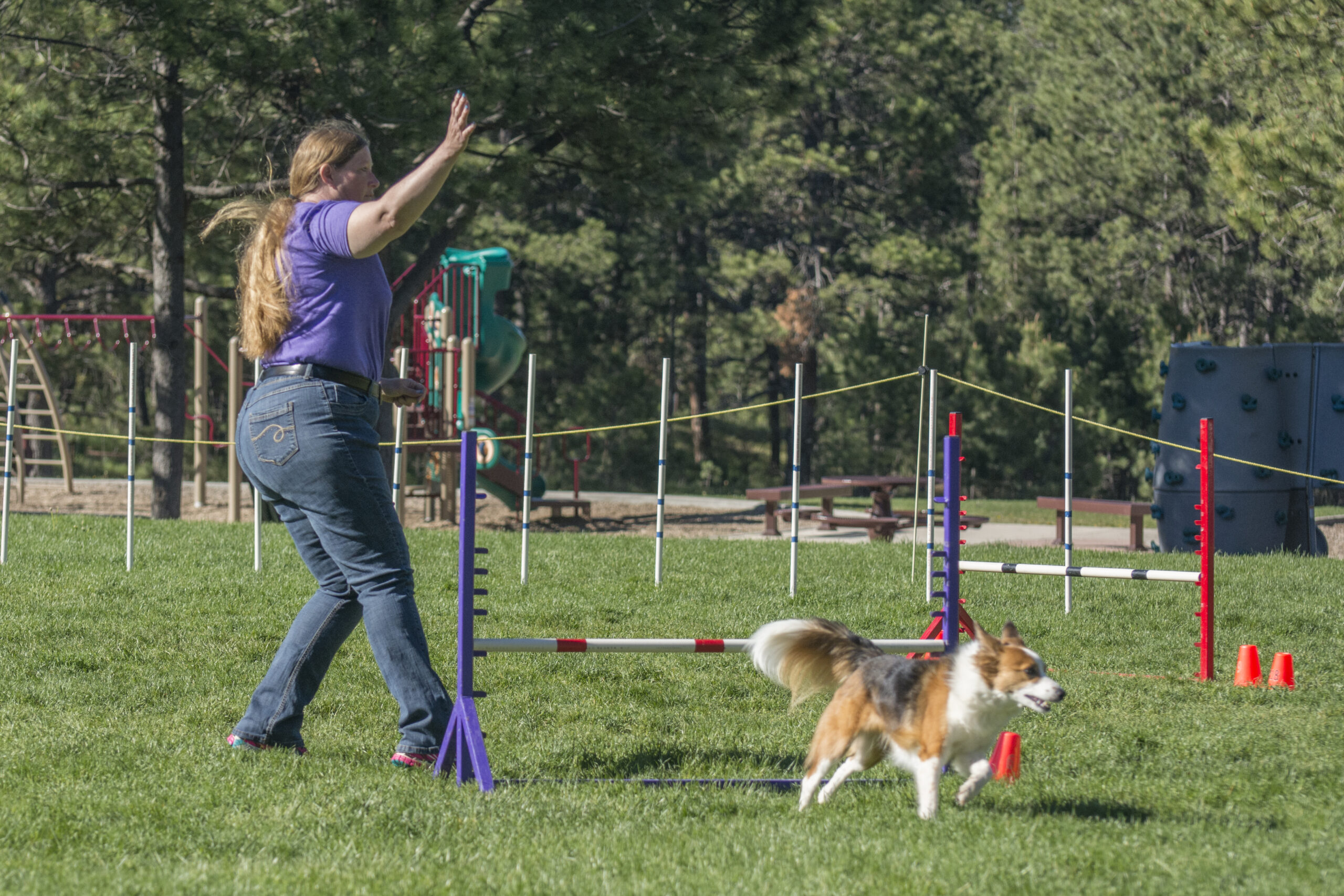
Dogs have to understand which way the handler wants them to turn. It does not mean drilling your dog on left and right and then trying to remember which one to use as you are handling your dog around the course. Directionals rely on a system of cues that indicate that your dog should turn away from you in the direction indicated by your body language.
The foundations for directionals are consistent throughout from the foundational spin, to the rear cross, to the turn away at a distance. They all rely on the same body language cues so they are clear to the dog as the skill is built from a basic spin to a turn away at 50 feet.
Skill 4: Lateral and Forward Distance
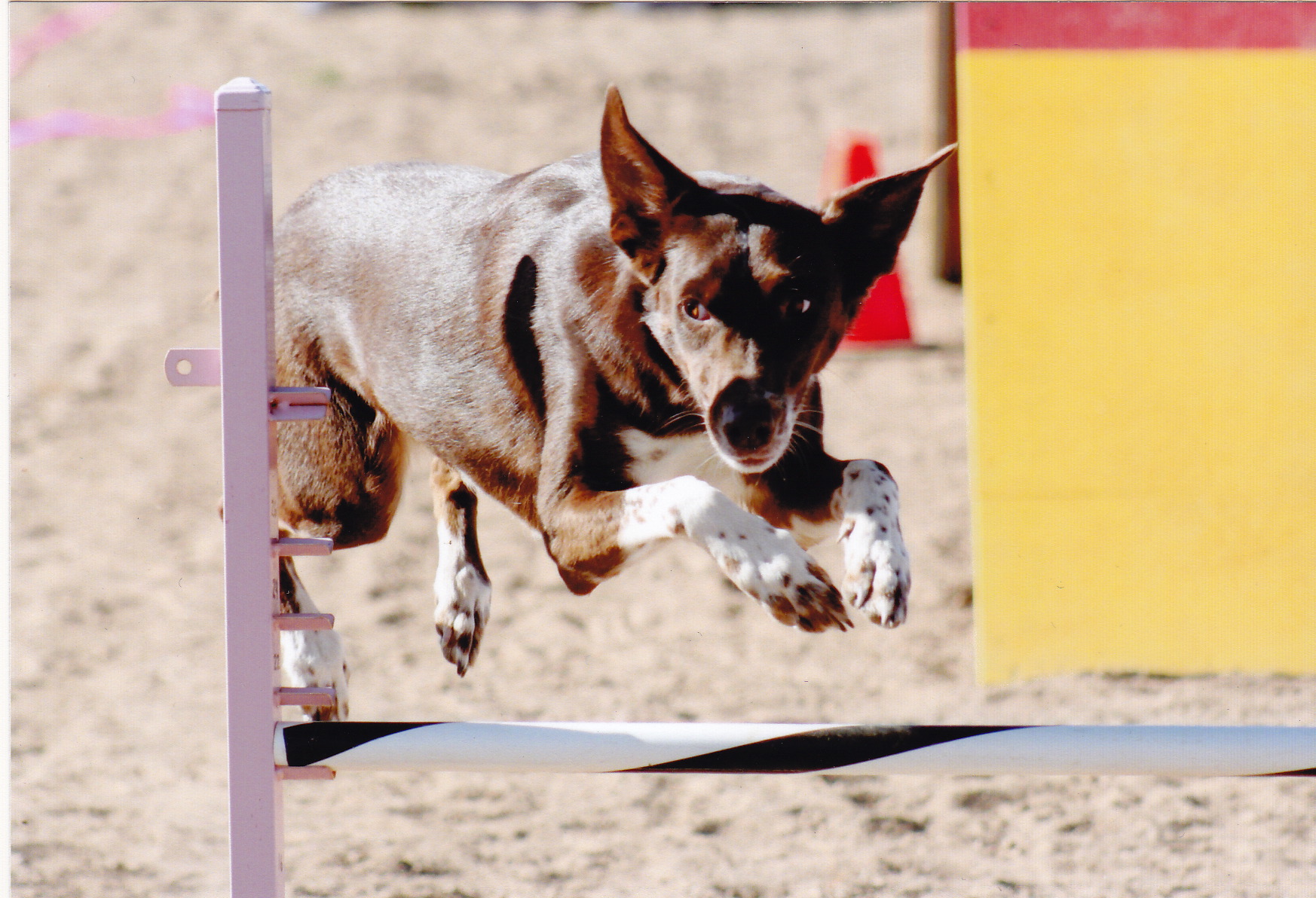
It may seem silly to say that distance handling requires lateral and forward distance, but they are two very distinct skills. For forward distance, the dog has to be able to move ahead of the handler without stopping, slowing, or questioning the handler as long as the correct cues are given.
Lateral distance means the dog can continue to move away laterally from the handler, even if the handler is caught behind a restriction line in a gamble, or is layering an obstacle like the dog walk. It also includes the ability to move in parallel with the handler when the dog and handler are separated from each other.
Skill 5: Understanding Your Dog’s Speed and Path
The last skill is a handler skill rather than a dog skill, and it includes two facets. The first is the ability to understand the dog’s speed so that the handling path can be planned. If the handler doesn’t know how quickly the dog can run the course, they can’t develop a handling plan that will help the dog.
The second facet is understanding the best path for a dog. In the distance games, especially those that allow teams to plan their own path in the opening, the handler has to understand the best path for their dog. Some dogs excel at tight turns and are happiest when doing several short sequences that are in close proximity. Other dogs do better when they are allowed to run in extension and really stretch out. The path for those dogs should not include a lot of tight turns or sharp directional changes.
Now that we’ve taken a brief look at the five skills required for distance handling, we can move to the next important concept for distance, and that is the framework that ties it all together.
The 6 Cs: The Framework Behind Every Successful Distance Team
If you watch teams who utilize distance on the agility course, you’ll soon notice a pattern. No matter which handling style or method they use, they have one thing in common: the ability to guide their dogs around the course using a consistent communication system that sometimes makes it appear as if their dogs can read their minds. That feeling of being connected to your dog when he’s working 60 or 70 feet away is almost indescribable.
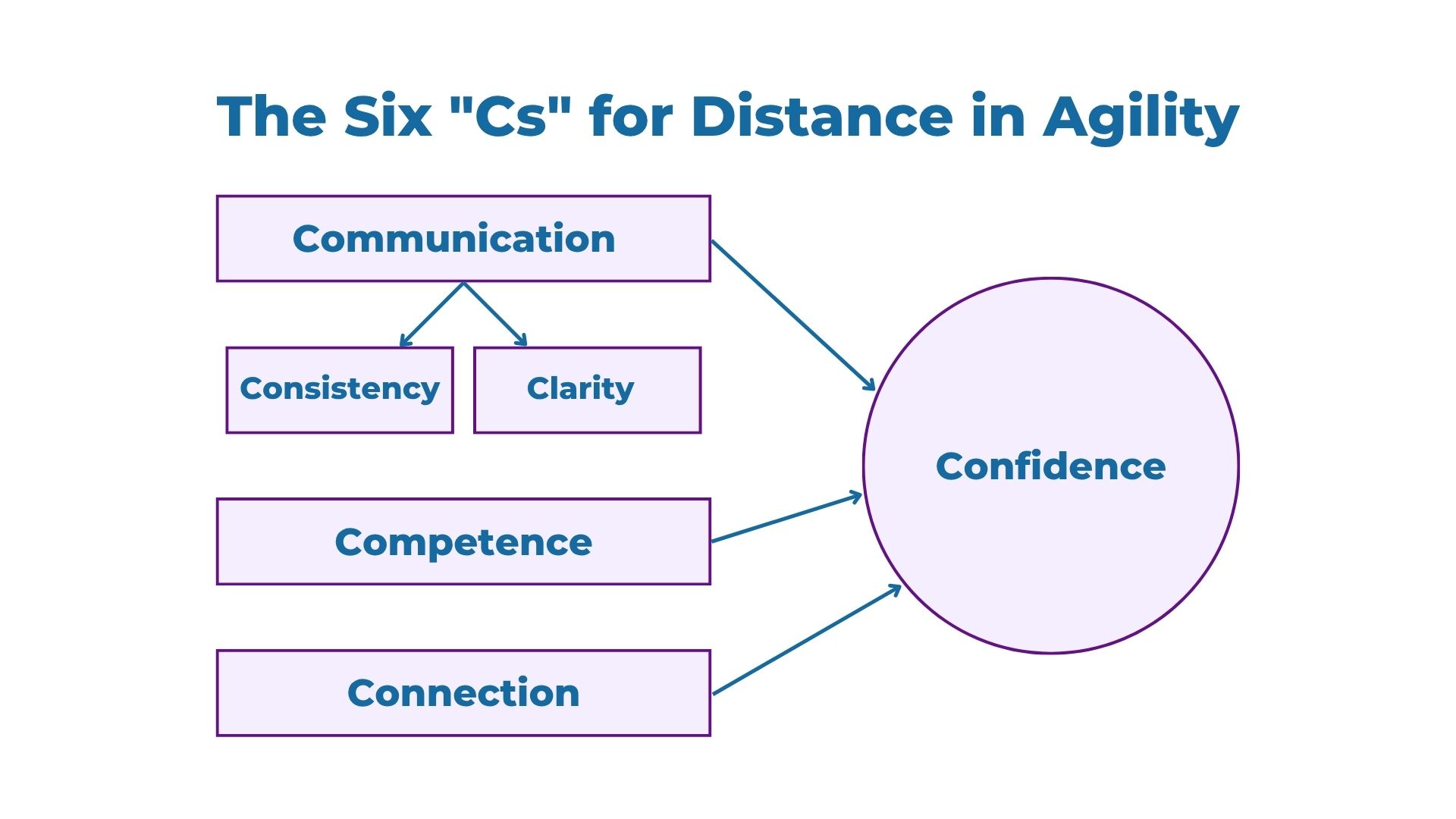
The framework behind that connection is what I call the 6 Cs. They are Communication, Clarity, Consistency, Competence, Connection, and Confidence. The 6 Cs work together to create a team that can successfully work at a distance with energy and joy. Confidence is the result of all the other Cs working together, which is why it comes last. You don’t train for confidence directly. You build the other five, and confidence is what your dog gains in return.
Communication
Communication is defined as a process by which information is exchanged between individuals through a common system of symbols, signs, or behavior. In agility, that means building a system of cues that both you and your dog understand to mean the same thing.
One of the foundational pieces I teach is what I call the hierarchy of cues. Even though we use a variety of cues on the agility course, there is an order of importance to each type from the dog’s perspective. Your dog’s primary cue is motion. Dogs are inherently social animals who want to move with the rest of the group, and on the agility course that means moving with you. The second most important cue is your body language and position. For example, if you lean forward, the dog naturally moves forward or away from you. If you stand up straight, your dog anticipates that you’re going to stop or turn, so he slows down or moves toward you.
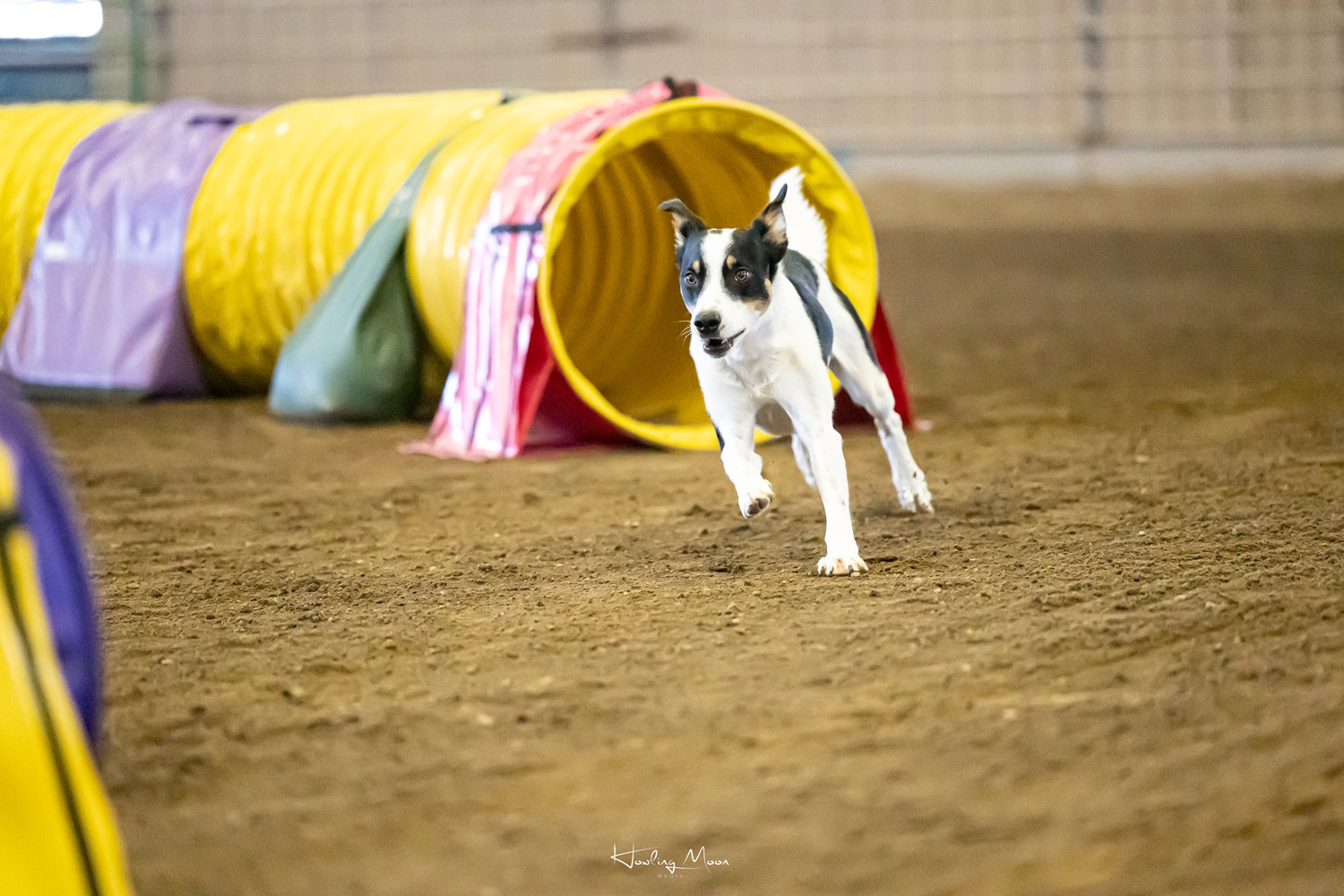
The three other types of cues in the hierarchy are position relative to the obstacles on the course, hand and arm cues, and verbal cues. Each type of cue is important, but the hierarchy explains how important they are to the dog inherently, without training. For example, you can definitely spend a considerable amount of time teaching verbal cues, but without training, that is the least important method of communication for your dog.
The goal is to build a communication system based on the natural importance of each type of cue from the dog’s perspective. When you understand how your dog responds to each type of cue, you can build a system that makes sense to both of you.
Clarity
Clarity is the quality or condition of being clear or easy to understand. Dogs respond to amazingly small nuances, which means even seemingly small changes in your cues can cause your dog to think they mean completely different things.
Clarity in your cues while running on an agility course means presenting the same cues without muddying them with extra words, unintentional steps to the side, or subtle changes in body language. Your cues need to be clearly differentiated. I often joke that the difference between the cue to take an outside obstacle versus the close obstacle should be clear enough that it’s like screaming to the dog without ever raising your voice.
Clarity of expectations is equally important. Your criteria for performance needs to make sense to the dog so they always understand what will get rewarded and what won’t. Making things crystal clear for the dog reduces frustration for both halves of the team.
Consistency
Consistency is the state or condition of always happening or behaving in the same way. If your cues are consistently given the same way every time, your dog will respond to them in a predictable way.
Inconsistent cues are confusing and frustrating for your dog. We want to develop a system of cues that means the same thing every time, and we want to apply those cues the same way every time.
Another aspect of consistency that people don’t always think about is expectations for improvement. Part of being consistent is expecting and rewarding the same amount of improvement across training sessions. If you take a single step back from a jump for the first four feet of distance and then suddenly take five steps back, you aren’t being consistent with what you’re asking for, and your dog is likely to get frustrated or confused.
Consistency also applies to rewards. You should reward for effort every time. If your dog tries to do what you are asking, even if a mistake is made, he has earned a reward. To be honest, the majority of mistakes are ours, so rewarding consistently is what keeps our dogs willing to work with us even when we mess up.
Competence
Competence is the ability to do something successfully or efficiently, and in agility it centers on independent obstacle performance. A dog that relies on the weave pole dance to get through the poles, or who has to have the handler right next to the contact zone to hit the yellow, has not been taught competence on those obstacles without assistance.
Independent obstacle performance is the most important skill for distance handling, and it’s the foundation everything else is built on. When you teach it using fun games, you end up with a dog who loves to play and doesn’t connect where you are with what he should do. The CLAWS framework is the tool I use to help students build and proof competence on every obstacle.
Competence also applies to your dog’s responses to handling cues. Once your dog understands the cues, your job is to practice them and proof them with distractions and in different environments until your dog responds to them reliably.
Connection
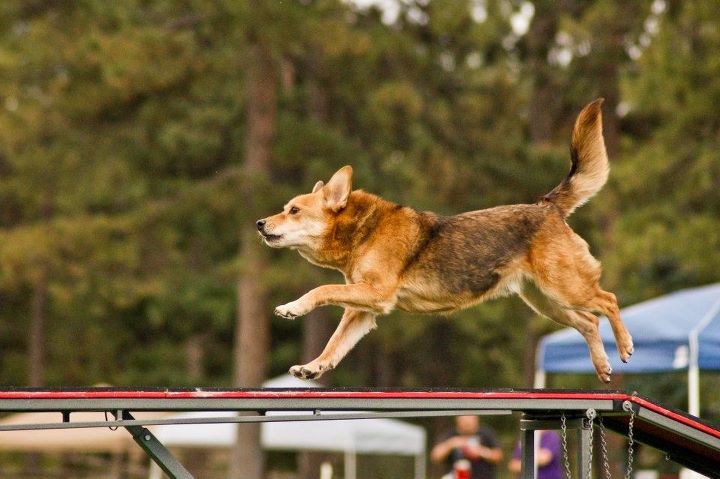
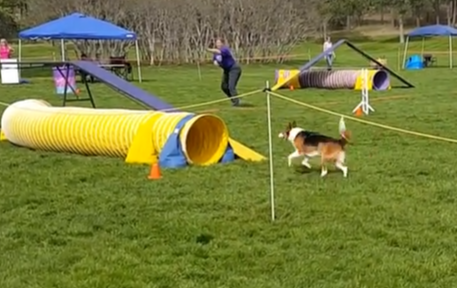
Connection is a relationship between two beings, and in agility it means making sure that you and your dog can see each other’s faces so the dog picks up cues about where to go next. It also means understanding what your dog is doing, where they’re headed, and how they’re feeling as you run together.
Connection does not mean staring at your dog around the entire course. During one seminar, I had two teams who had both been taught to look directly at the dog’s face while going around the course. Both dogs had a very difficult time taking an obstacle unless their partners were right next to it. Once they learned to look at the path they wanted the dogs to take instead, the dogs started moving five to six feet away to complete the obstacles. It was a start, and it greatly improved their understanding of what connection really means.
Another aspect of connection is engagement. The connected team is focused on working together to achieve the same goal. They are aware of each other while still accomplishing their individual half of the teamwork. Creating a strong connection with your dog leads to the ability to read each other on course, making agility a fun and flowing dance between partners rather than a series of cues and redirects.
Confidence
Confidence is the result of all the other Cs. When you’ve built a clear and consistent communication system, trained your dog to be competent on obstacles, and nurtured a strong connection through engagement and fun training methods, confidence is what your dog gains in return.
There are two types of confidence to build. The first is the dog’s confidence in their own skills. A dog who has this kind of confidence responds to a cue happily, understanding what is wanted and performing without hesitation. The second is the dog’s confidence in you. Clear and consistent communication, a strong connection, and consistent rewards all come together to allow the dog to understand that they can put their full trust in you to be their guide on the agility course.
One really critical thing you can do to build your dog’s confidence in you is to avoid correcting mistakes on course or in the middle of an exercise. Over the years I’ve learned that the vast majority of the time, a mistake on course is our fault. Either we were not clear with our cues, or we didn’t train the dog to the level he needed before putting him in the ring. Find a logical way to continue on course instead of stopping the game and going back to fix things. And handle the rare errors your dog makes with grace. They forgive us a lot, and we should give them the same courtesy.
The concept of the 6 Cs deserves its own dedicated deep dive, and that article is coming. For now, the most important takeaway is that they work together as a system, not a checklist. Start with communication, build clarity and consistency into everything you do, develop competence through smart training, nurture your connection, and confidence will follow.
How to Train Distance Skills
Training distance skills requires the right approach from the very beginning. The way you reward your dog, the state your dog is in when you train, and the structure of your training sessions all have a significant impact on how quickly your dog gains confidence and independence. Let’s look at each piece.
Reward Value, Placement, and Delivery
One of the most overlooked aspects of distance training is not just how you reward your dog, but also when, where and with what. All four matter more than most handlers realize.
Reward Value
Dogs are enthusiastic about training when they value the reward. The catch is that handlers don’t get to determine what is actually rewarding to the dog. The dog does. We assume dogs should work for high value treats and typical toys, but sometimes those things aren’t what motivates the individual dog.
During one seminar, I worked with a sighthound named Sprint who would do one or two obstacles and then wander off to explore, return to her crate, or zoom around the ring. She had been cleared by a vet, her instructor used positive methods exclusively, and she simply didn’t seem interested in food or traditional toys. What we eventually discovered was that Sprint loved to chase things. We rigged up a makeshift lure from a fishing rod, some twine, and a plastic bag, and suddenly Sprint was flying over jumps and through hoops with more enthusiasm than she had ever shown. All for the chance to chase a plastic bag.
Don’t limit yourself to standard treats and thrown or tugged toys when you are searching for something your dog loves. Rewards can be activities like getting to jump in a baby pool, chasing a squirt bottle, or in Sprint’s case, chasing a lure. Find something that is truly motivating to your individual dog if you want them to work with enthusiasm.
Reward Placement
Where you reward your dog is just as important as what you reward with, and it has an enormous impact on distance training specifically.
If you always reward your dog while he is standing right in front of or next to you, you are unintentionally teaching him that coming back to you is the goal. And then you wonder why he won’t stay out on the line.
I worked with a handler whose dog ran straight back to her after every two or three obstacles. She thought her dog needed better distance training. As I watched them work, I realized distance wasn’t the issue at all. Her dog had learned that the only place he was ever rewarded was right in front of her, so he had no motivation to continue on a line. He also didn’t know when the reward was coming, so he checked back frequently just to see if it was time.
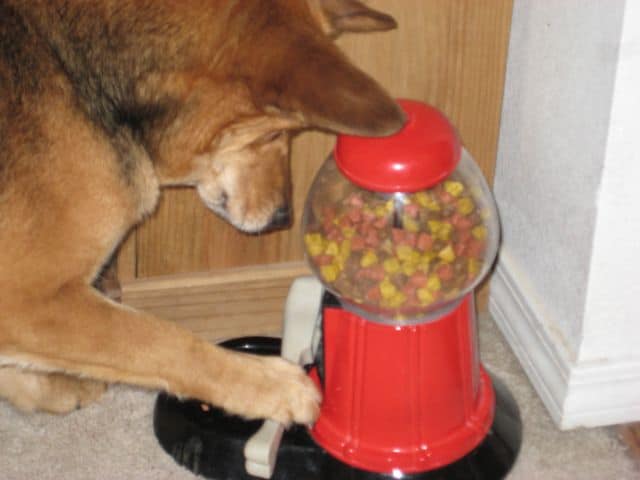
The fix is to reward your dog while he is away from you. You can throw a toy or toss treats directly to the dog when he is in a stationary position like the bottom of a stopped contact, or throw ahead of the dog to encourage him to keep moving forward. A sealed container or pouch placed at the end of a sequence gives your dog something to drive toward. A training partner can toss a reward when your dog completes a sequence at a greater distance. A mark bucket or target can give your dog a destination to drive to while you maintain your position.
The principle behind all of these methods is the same. Rewarding away from you decouples the reward from your presence, so your dog doesn’t default to running back to you every time he thinks a reward might be available. For further information, see 5 Ways to Reward Your Agility Dog for Distance Training.
Reward Delivery and Frequency
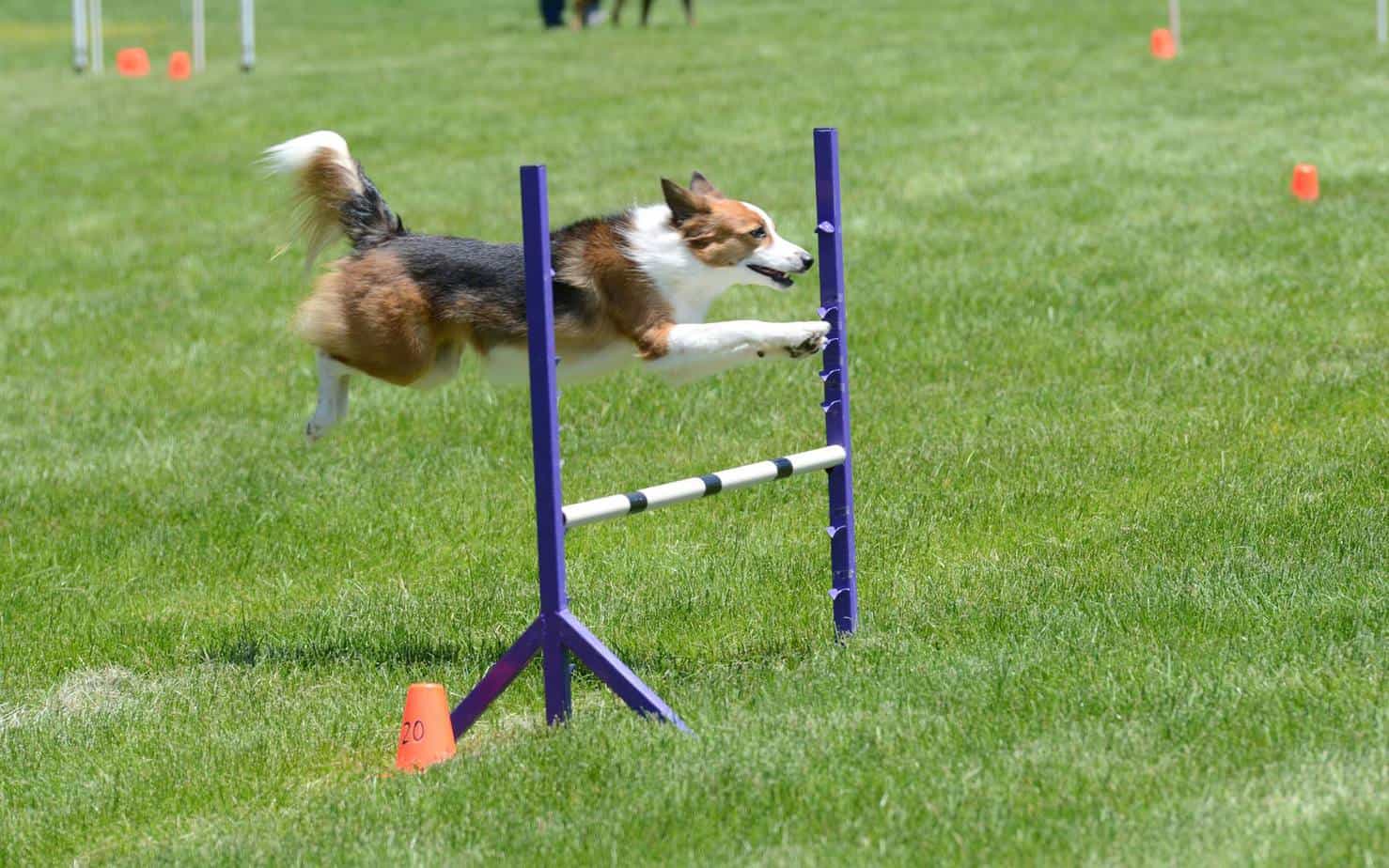
How often you reward matters just as much as where and with what. For dogs who are easily over aroused, who tend to bark, spin, or circle when frustrated, rewarding every attempt is essential. When a dog tries to do what you are asking, even if a mistake is made, that effort has earned a reward. Withholding rewards from a highly aroused dog doesn’t create more precision. It creates frustration, and frustration shows up as the exact behaviors you are trying to avoid.
Rewarding consistently also keeps your dog willing to work with you even when you make mistakes, which as we’ve already established, happens more often than we’d like to admit.
Reward Expectations
As my training has evolved, I’ve experimented with and found value in reward markers. For dogs who live for the toy or food you are using, frustration is created when they don’t know when that reward will be available.
Reward markers replace the traditional marker word like “yes” that I used in the past. Instead of just telling the dog “Yes, you did that right,” I can tell the dog “Yes, you did that right and your food or toy is being given to you this way.” If I say “treat,” I am feeding from my hand. If I say “search,” I am tossing the treat on the ground. “Get it” means I’ve thrown the toy for the dog to chase, and “tug” means the dog is free to come in and tug as a reward.
Using reward markers not only clears up confusion for the dog around where their reward will be, it also allows them to understand when the reward is coming. They can quit trying to anticipate the reward, which causes them to come in or turn back to the handler, and focus on their job until they hear the magic word.
With a solid understanding of how to reward your dog effectively, you are ready to look at one of the most powerful structural tools for distance training: loopy training.
Loopy Training: How Patterns Help Dogs Learn
One of the most powerful structural tools you can use when teaching distance skills is loopy training. The concept is simple but the impact on your dog’s learning, confidence, and arousal level is significant.
Loopy training is a method of structuring your training sessions so that one repetition flows seamlessly into the next, creating a predictable pattern that your dog can anticipate and settle into. Instead of stopping after each attempt to reset and start again from scratch, the loop keeps the dog moving and engaged. The reward becomes part of the flow rather than an interruption of it.
We’ll use an example of a pinwheel. You send your dog over the first jump in the pinwheel, cue the second and third jumps, and reward as he completes the pattern. As you reward, whether with food or a toy, you are moving back toward the beginning of the pattern. You could play tug with the reward until you are back where you started, or continuously reward with treats as you are returning. This sets the dog up for the next repetition.
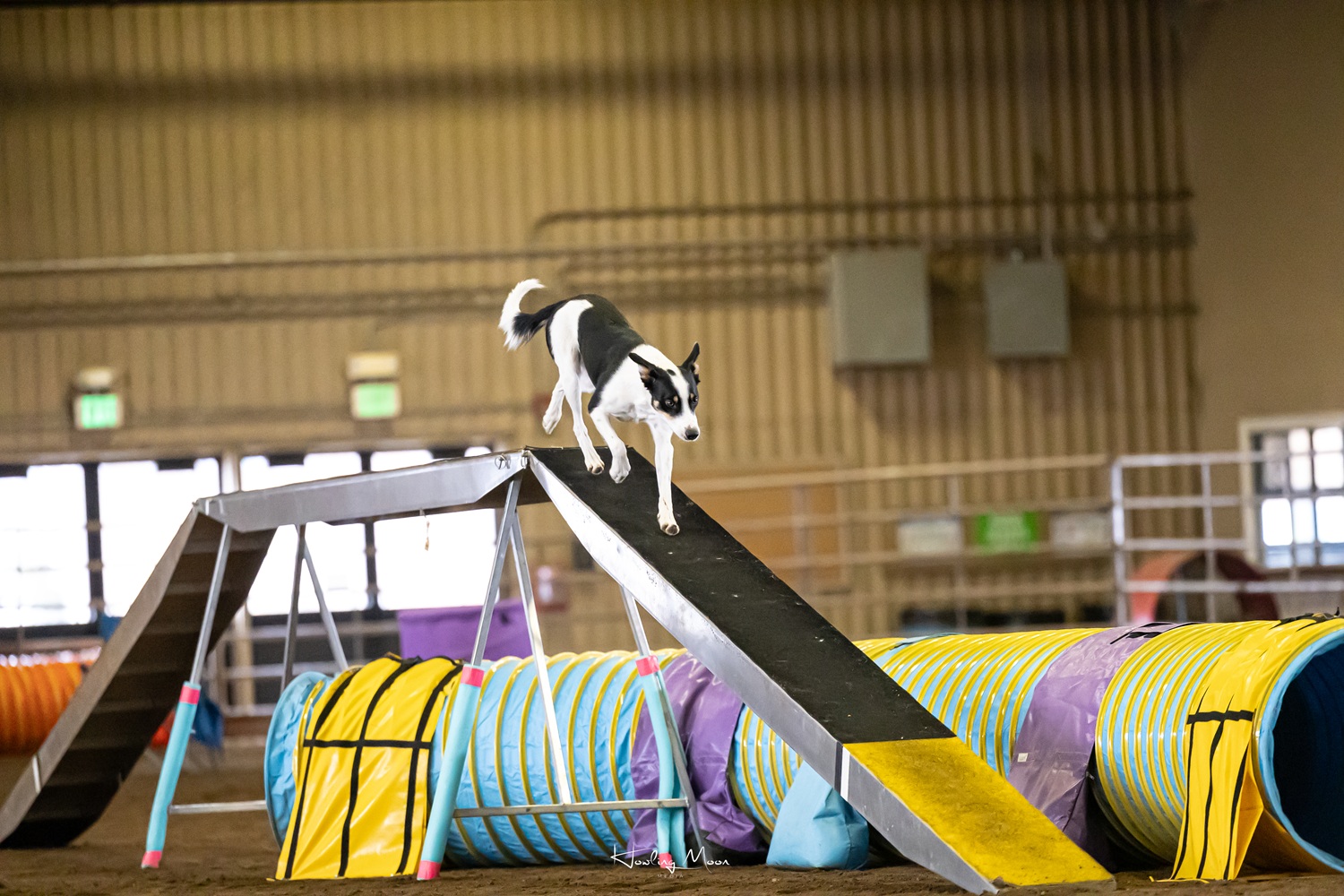
Once you get two clean repetitions in a row, with no bobbles or extraneous behaviors, you change something about the pattern so the dog doesn’t either get bored or wonder if they are doing something incorrectly. For example, you could move a little further back and send at a greater distance.
One big thing to remember is that every attempt gets rewarded, and you try not to break the flow, no matter what. In our example, if the dog misses the second jump of the pinwheel, you would continue to the third and reward, then figure out what needed to change about your handling on the next round.
The predictability of the loop is what makes it so valuable for distance training specifically. When a dog knows what to expect, his arousal stays at an optimal level, his confidence grows, and his focus stays on the job rather than on trying to figure out what comes next. He is able to repeat the pattern with you further and further away because he understands it and is getting rewarded.
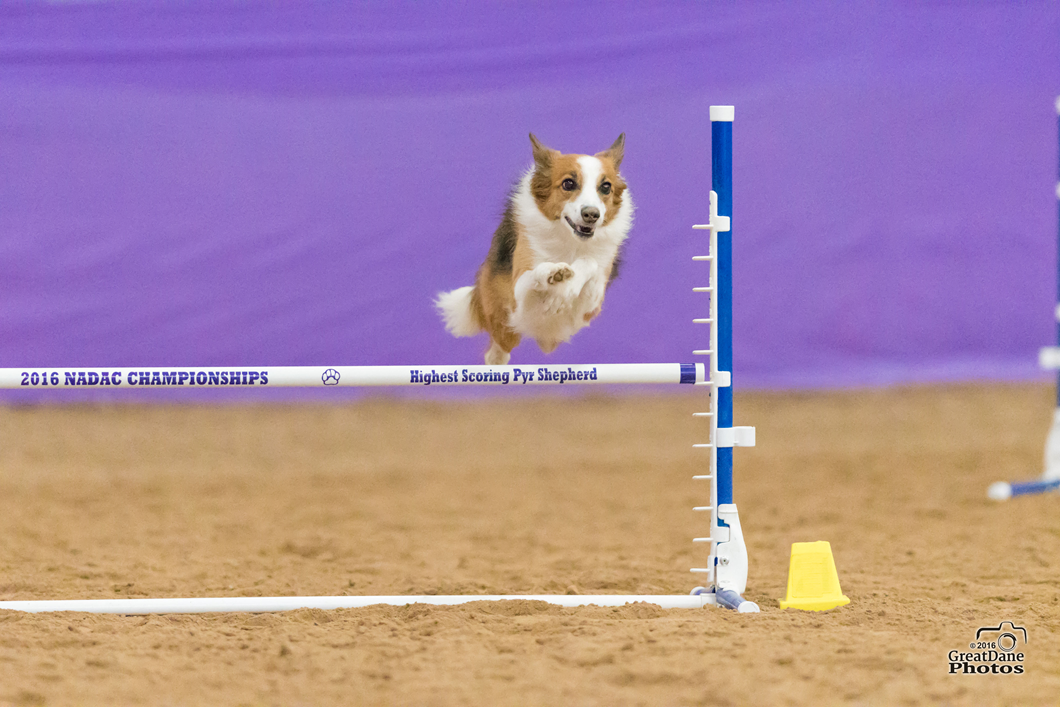
Each repetition reinforces not just the obstacle performance but the entire pattern of moving away, working independently, and driving forward to a reward. Uncertainty creates hesitation. Patterns create confidence.
Loopy training also reduces the frustration that can build up during repetitive training sessions. Because the dog understands the rhythm of what is happening, there is less confusion between attempts. The dog isn’t left wondering whether the session is over, whether a reward is coming, or what is expected next. That clarity keeps the session feeling like a game rather than a test.
As distance increases, the loop can be adjusted to accommodate the new criteria while keeping the same predictable structure the dog has come to rely on. The pattern stays the same even as the difficulty grows, which means the dog’s confidence travels with him as the training progresses.
Arousal State and Why It Matters in Distance Training
The state your dog is in when you train has a direct impact on how well he learns and retains new skills. Arousal state is a complex subject, but at a basic level it refers to how activated or stimulated your dog is at any given moment, and finding the sweet spot for your individual dog is one of the keys to productive distance training. Arousal and drive are two completely separate subjects.
Dogs who are optimally aroused are ready to learn and are motivated. Over arousal can manifest in different ways. When animals, not just dogs, are over aroused, there is a continuum of states they can be in. You’ve probably heard of Fight or Flight. The full spectrum is Fight, Flight, Fawn, Freeze, and Overwhelm.
A dog who is over aroused and in the Freeze state is disengaged, slow to respond, and unlikely to offer the enthusiasm and drive that distance training requires. We often describe them as a dog who “stresses down.” If we continue to try to train them in that state, they can either move into the Fight, Flight, or Fawn direction, or they can become overwhelmed and completely shut down.
A dog who is over aroused and in Fight or Flight mode is too stimulated to think clearly, too frantic to respond to cues with precision, and likely to offer the exact behaviors we talked about earlier: barking, spinning, circling, and getting the zoomies. Dogs who seek more assurance when they are over aroused end up in the Fawn state, where they are leaning on you, licking, jumping up, or won’t leave your side.
The optimal arousal state for learning sits outside of the extremes of Fight, Flight, and Fawn on one end, and Freeze on the other. Learning to read your dog’s arousal state before and during training sessions will make you a more effective trainer. If your dog is showing signs of over arousal, shorten your sessions, simplify your criteria, and make sure you are rewarding every attempt to keep frustration from compounding.
Arousal state also interacts directly with how you structure your training sessions. A well structured training session with a predictable rhythm helps regulate arousal naturally, becoming calming for a dog who might otherwise spin out, and energizing for a dog who might otherwise switch off.
Building in Small, Consistent Steps
One of the most common mistakes handlers make in distance training is jumping too far, too fast. A dog who can send to a jump from five feet away is not necessarily ready to send from twenty feet away. The gap between those two things is enormous from the dog’s perspective, even if it doesn’t feel that way from yours.
Consistent, incremental progress is the foundation of every skill we have talked about in this article. You saw it in the 6 Cs when we discussed consistency, and it applies just as directly to how you build distance. The goal is to increase difficulty in steps small enough that your dog barely notices the change. Each small success builds confidence, and that confidence is what allows the dog to stretch a little further in the next session.
Steven Kotler, who performs flow state research, suggests that in humans, to maximize focus and skill acquisition, the challenge of a task should increase by approximately 4% at every successful step. I believe the same rule is applicable to dogs, and try to gradually increase the difficulty when training for distance.
A useful rule of thumb is to never move on until you have two clean repetitions at the current level of difficulty. If your dog is struggling, that is a signal to make the exercise easier or change your handling to be clearer, not to push through.
Going back to an easier step is not failure. It is good training. The dog who masters each step thoroughly before moving on will always outperform the dog whose training skipped steps along the way.
This principle applies to every aspect of distance training. If you are building lateral distance, add one step at a time. If you are building forward distance, send a little further each session rather than doubling your distance overnight. If you are adding distractions or new environments, do so without also increasing distance at the same time. Change one variable at a time, and change it gradually.
The handlers who make the fastest progress in distance training are almost always the ones who are willing to go slowly. It feels counterintuitive, but small consistent steps get you to your goal faster than big leaps that erode your dog’s confidence along the way.
Common Mistakes Handlers Make with Distance Training
Even handlers who understand the value of distance training and are committed to building it can get tripped up by a handful of mistakes that slow progress and undermine their dog’s confidence. Here are the most common ones I see in my seminars and workshops.
No Training Plan Equals No Training Success
One mistake I see many handlers making is overlooking the importance of planning. Start each training session knowing what you are going to work on. Ideally, you will have thought through your overall goals, broken them down into skills, and written those skills down to form the beginning of a training plan. Even better if you have decomposed those skills into steps you need to teach and have them planned out for each session.
It is very difficult to execute loopy training sessions without a plan. Make sure to have a clear plan for not only your dog’s agility training session, but also your overall training goals, and adjust them as necessary as your dog’s skills improve.
Defining Criteria Is Critical
Defining criteria for dog agility training means knowing exactly what the final behavior will look like when it is fully mastered, and knowing which steps along the way you are going to work on. If you don’t have a clear picture of what the end result will be, you can’t teach it to your dog in any meaningful or effective way.
Take the example of a stay, for the start line or elsewhere. If you just have a general idea of what you want, you may reward your dog if he stays but changes position. That would be okay, if you never needed him to stay in a specific position. But does that also mean he can move his feet? Get up? Step toward the first obstacle?
Fuzzy criteria equals fuzzy behaviors. Trainers end up rewarding inconsistently when they don’t have clear criteria. Dogs get confused by the logic of sometimes getting rewarded for moving their feet a little but not for moving them more. The more concrete you make your criteria, and the more consistently you set up training so you can get clean loops, the faster your dog will learn the task.
Adding Distance Before Independence Is Solid
This is the most significant mistake by far. Handlers get excited about working at a distance and start pushing further back before their dog has truly learned to perform obstacles independently. If your dog needs you next to the contact to hit the yellow, or pops out of the weaves when you move away, adding distance is only going to make those problems worse.
Independent obstacle performance is the foundation that everything else is built on. If it isn’t solid, go back and build it before you do anything else. The distance will come as the dog gains better understanding of the criteria for completing the obstacle and builds confidence in being able to do it.
Correcting Mistakes Instead of Continuing
When a dog makes a mistake on course or in a training exercise, the instinct for many handlers is to stop, go back, and fix it. As we discussed in the 6 Cs section, this erodes your dog’s confidence in you and breaks the flow of the training session.
In most cases the mistake was ours anyway. Find a way to continue, reward, and then figure out what needs to change before the next repetition. If you are in a trial and your dog has made a mistake, most of the time he will not qualify anyway, so keep going and continue the flow.
Inconsistent Cues
If your cues mean different things in different situations, your dog cannot build a reliable understanding of what you want. Inconsistent cues are one of the most frustrating things a dog can experience, and frustration is the enemy of distance work.
Go back to the Communication and Clarity sections of the 6 Cs and audit your cueing system honestly. Are you giving the same cue the same way every time? If your dog is becoming over aroused, barking, spinning, and running back at you, consistency may be one of the keys to solving the issue.
Staring at Your Dog Instead of the Path
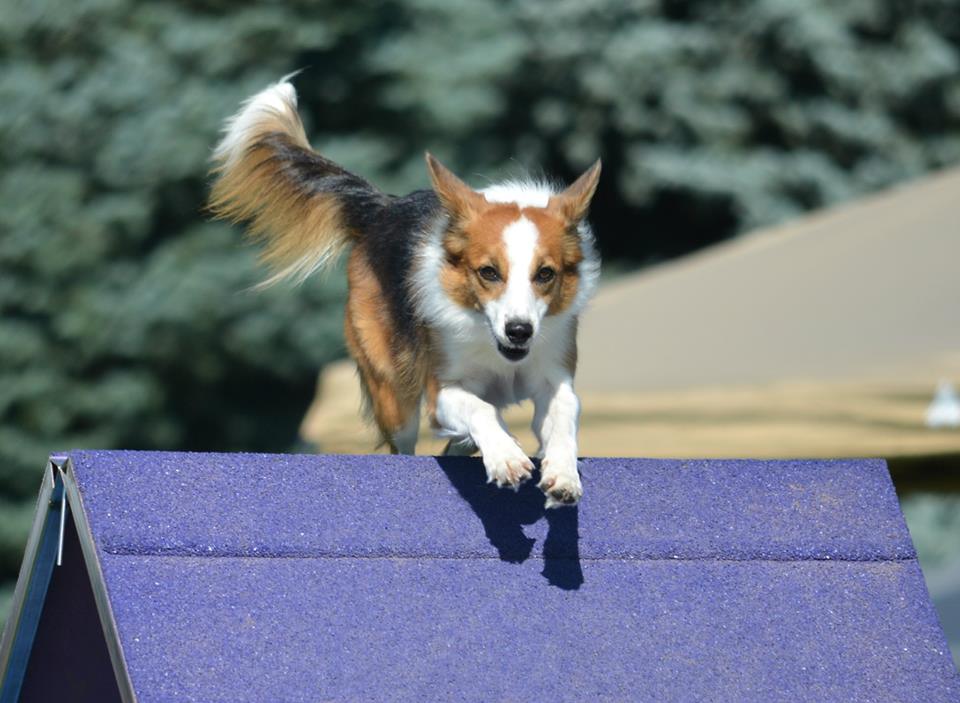
Connection does not mean watching your dog’s every move and staring directly into his eyes. As we covered in the 6 Cs, your dog needs to see at least the side of your face so he can read your cues, but you need to be looking at the path you want him to take.
Handlers who stare directly at their dogs inadvertently pull them in, because the dog is reading their body language and orientation rather than the path ahead. Look where you want your dog to go and his body will follow.
Jumping Difficulty Levels Too Fast
We covered this in the Building in Small Consistent Steps section, but it bears repeating here because it is such a pervasive problem. Going from five feet to twenty feet overnight, or adding a new environment while also asking for more distance, sets your dog up to struggle.
Keep the 4% rule in mind and resist the urge to push further than your dog is ready to go. The handlers who go slowly make the fastest progress in the long run.
Drills Are Boring for Your Agility Dog
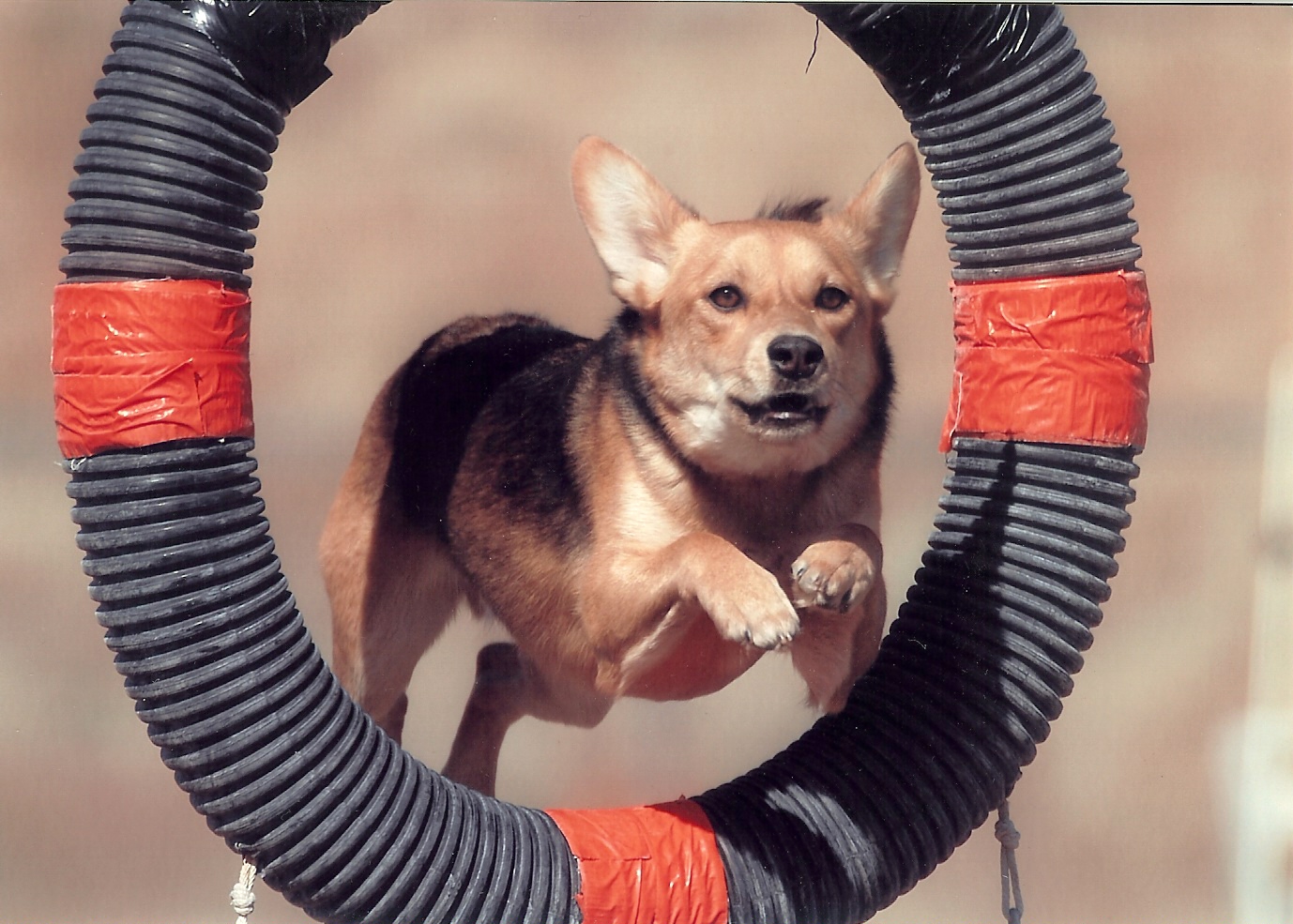
While practicing skills on a short sequence is a great way to fine tune your handling and performance, practicing the same skill on the same sequence over and over again is not only boring to your dog, but has no value.
Asking your dog to do the same thing repeatedly without any changes makes dogs second-guess whether they are doing it right and can cause frustration and off-courses. If your dog completes the exercise twice correctly, change something. Change the distance you are sending him, your handling position, the angle of a jump, or something else so you are not drilling your dog. This will allow you to continue to increase your skills as a team.
What Distance Handling Is Not
Before we wrap up, it is worth clearing up a few misconceptions that can get in the way of handlers embracing distance work.
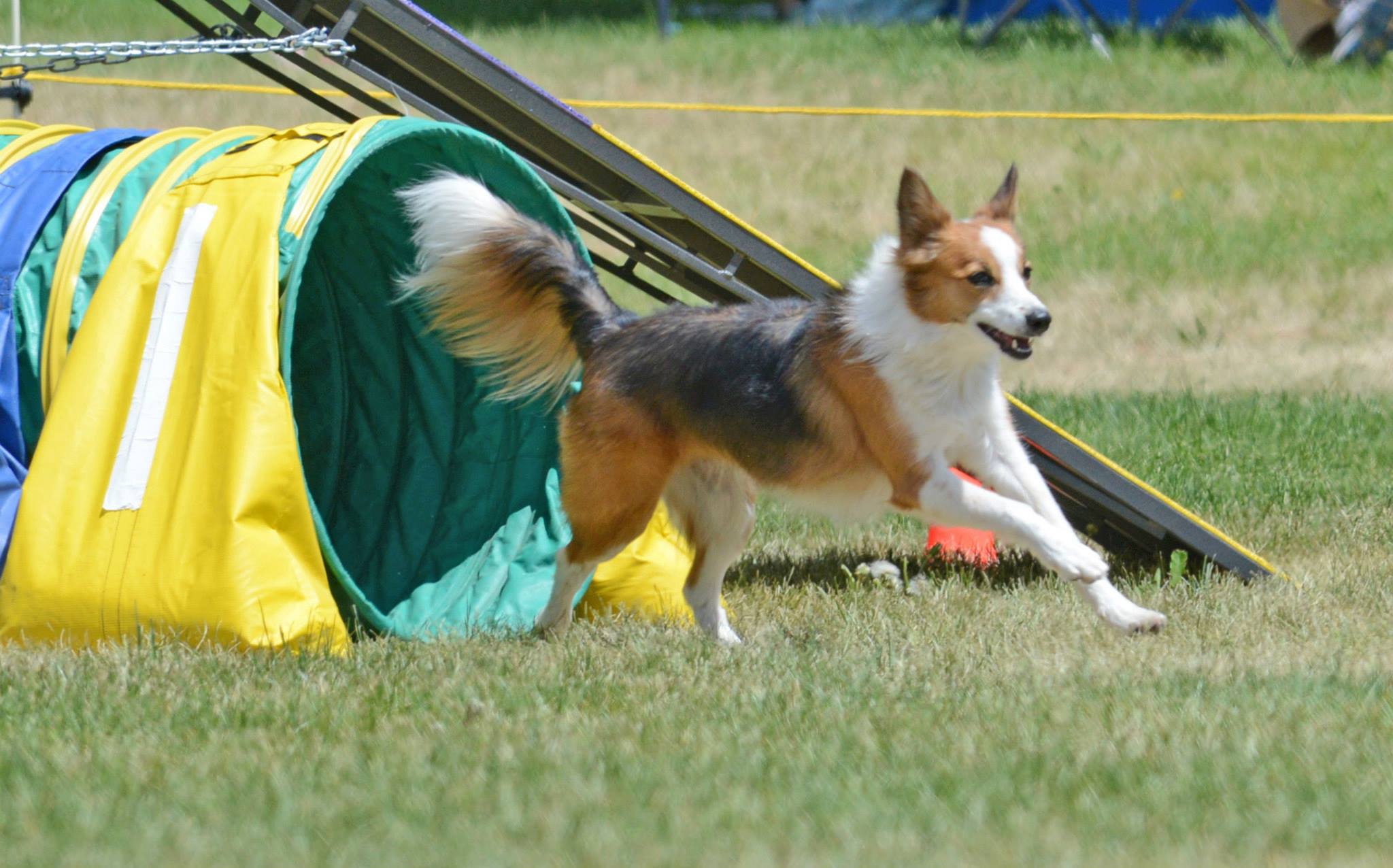
It is not just running far away from your dog. Physical distance between you and your dog means nothing if your dog doesn’t understand how to read your cues from that distance, perform obstacles independently, or maintain confidence without you right beside him. Distance without the underlying skills is just confusion with more space between you.
It is not letting your dog make his own decisions. A well trained distance dog is not running around the course with no direction. He is reading a clear and consistent communication system and responding to it accurately from further away than most handlers think is possible. The handler is still guiding every step. The difference is that the guidance is coming from body language, motion, and a shared understanding of cues rather than from proximity.
It is not only for advanced or elite teams. Distance skills can and should be introduced from the very beginning of an agility career. I incorporate independence and distance into all of the fundamental skills I teach my dogs. In fact, teaching independence and distance from the start is far easier than trying to add it later after a dog has learned to rely on the handler being right beside him. If you are a new handler, you are in the perfect position to build this foundation right from the beginning.
It is not out of reach for you. No matter your dog’s breed, your athletic ability, your experience level, or your competitive goals, distance handling has something to offer your team. The framework exists. The training methods work. All that is required is a willingness to start.
Where Do You Go From Here?
Distance handling is a journey, not a destination. The skills build on each other, the confidence grows with every successful session, and the teamwork that develops along the way is one of the most rewarding things you will experience in agility.
If you are just starting out, begin with independent obstacle performance. It is the foundation that every other distance skill is built on, and time spent there will pay dividends across every other area of your training. Work through the CLAWS framework, reward away from your body, keep your sessions structured and your steps small, and let your dog’s confidence be your guide for when to push further.
If you are an experienced handler looking to expand your distance or troubleshoot a specific challenge, go back to the 6 Cs and audit your system honestly. Communication, clarity, and consistency solve the majority of distance problems when they are applied thoughtfully and patiently.
The articles linked throughout this guide will take you deeper into each of the skills and concepts we have covered here. As new articles are added they will be linked here as well, so this page will continue to grow as a resource for your distance handling journey.
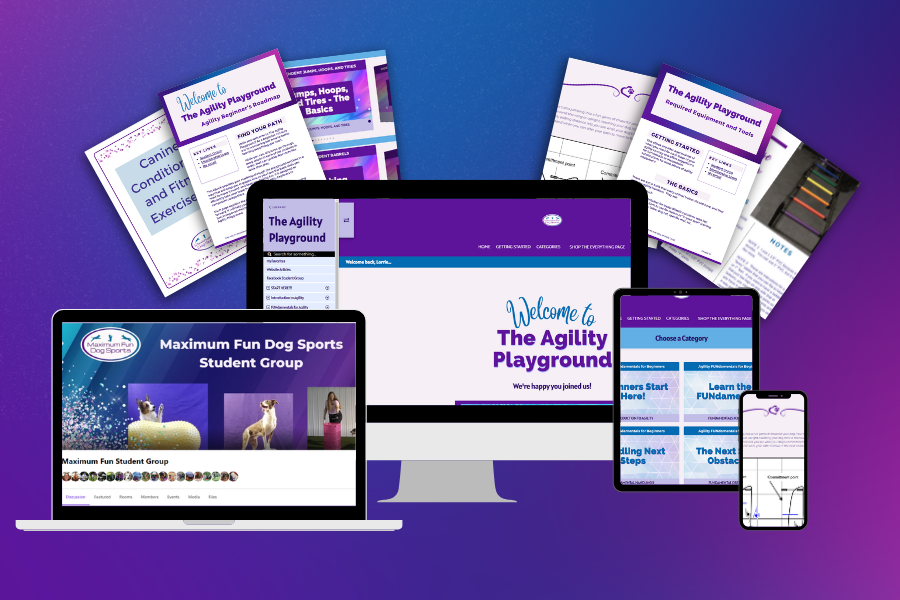
And if you are ready for a structured, step by step approach to building distance skills from the ground up, my membership, The Agility Playground, walks you through everything covered in this guide and much more, with exercises, video examples, and the kind of detail that turns concepts into real progress for your team.
Whatever your starting point, the most important thing is to begin. Your dog is ready when you are.
You Might Also Like…
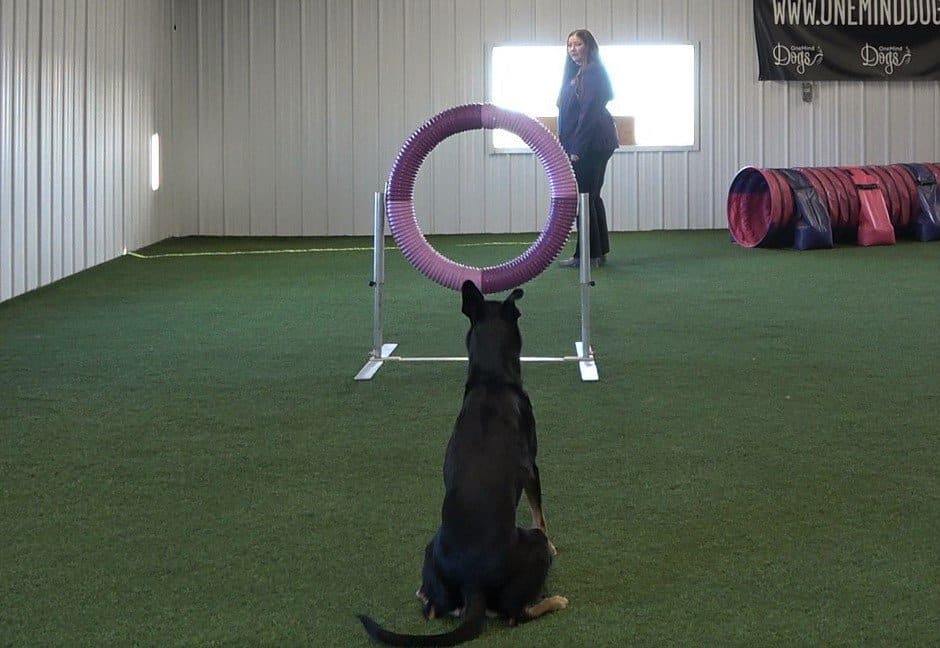
Dog Agility Distance Training – What is the CLAWS Framework?
Independent obstacle performance is the foundation of dog agility distance training. Learn what CLAWS means and how this simple framework can transform your distance work.
5 Ways to Reward Your Agility Dog for Distance Training
If your agility dog keeps running back to you mid-run, reward placement may be the issue. Here are 5 ways to reward your agility dog for distance that actually work.
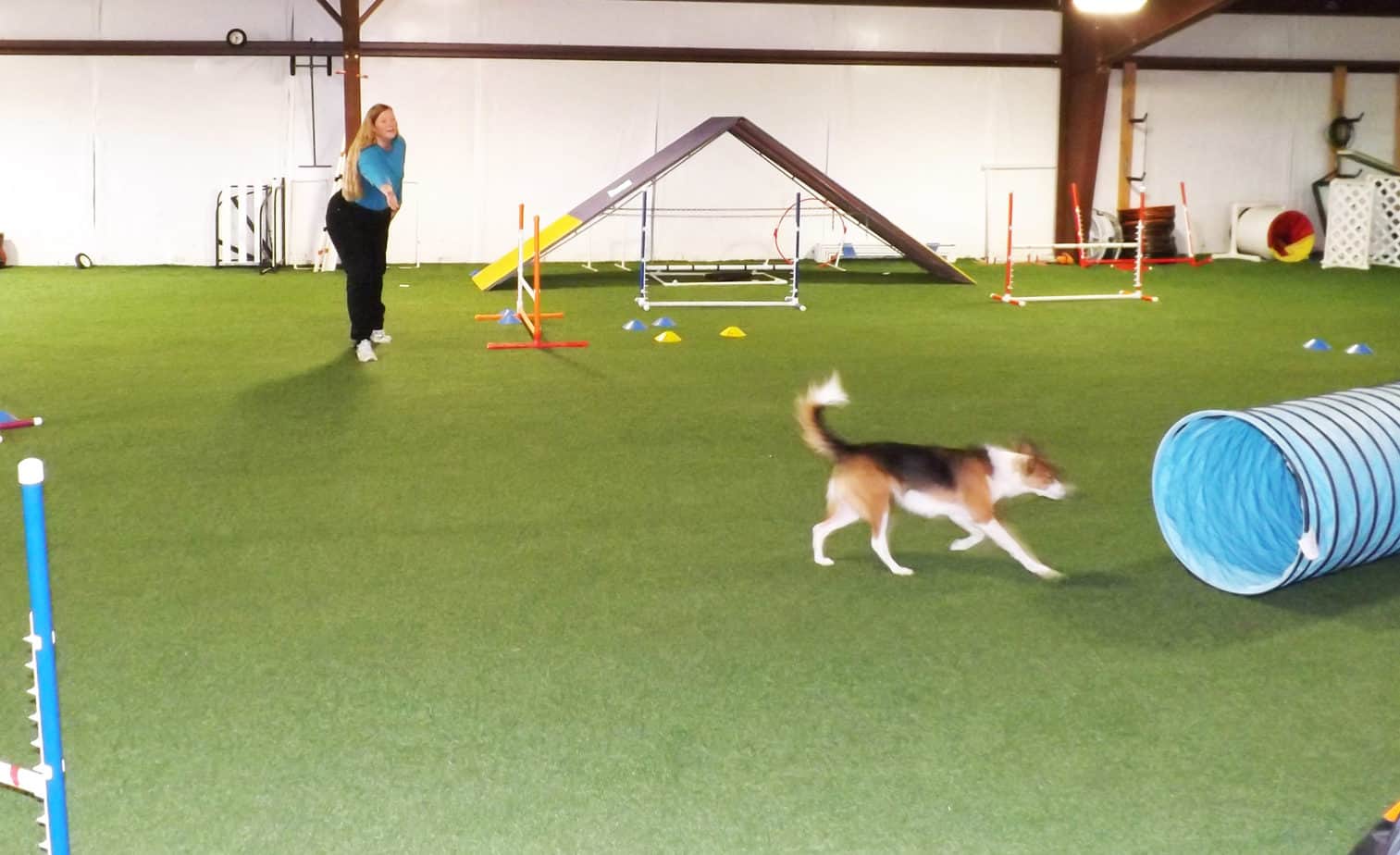
5 Dog Agility Distance Skills That Are Essential for Every Team
Want to succeed at Gamblers, FAST, and Chances? These 5 dog agility distance skills are what every team needs to handle distance confidently and consistently.
Cover photo courtesy of Howling Moon Photography
Photo 1 courtesy of Tanya Lee Photography
Photos 2, 7, 12, 13, 14, 16, and 19 – personal photos
Photos 3, 10, 17, and 22 courtesy of Howling Moon Photography
Photos 4, 6, 9, 21, and 27 courtesy of Stover Photography
Photos 5, 11, 15, 20, 24, and 26 courtesy of Dog Agility Photos for Fun
Photos 8 and 25 courtesy of Ken Gee Photography
Photo 18 Copyright 2016 Great Dane Photos. Used with permission.
Photo 23 courtesy of Katelyn Scott Photography