
Written by Lorrie Reynolds
Planning Your Agility Path to Stay Away From the Distance Line
We were walking a Chances course at an agility trial together and I noticed that her handling path was taking her way too close to the distance challenge line. “Stay off the line,” I reminded her.
“You know,” she laughed, “I hear you saying that in my head every time I walk a Chances or Gamblers course.”
I heard someone snicker behind me. “Me too,” said another of my seminar students. “That and ‘The line is not your friend.’ – every time I walk.”
Although I think it is hilarious that students “hear me” inside their heads, I am grateful that one of my most important lessons sticks with them.
Your content goes here. Edit or remove this text inline or in the module Content settings. You can also style every aspect of this content in the module Design settings and even apply custom CSS to this text in the module Advanced settings.
Why the Distance Line is “Not Your Friend”
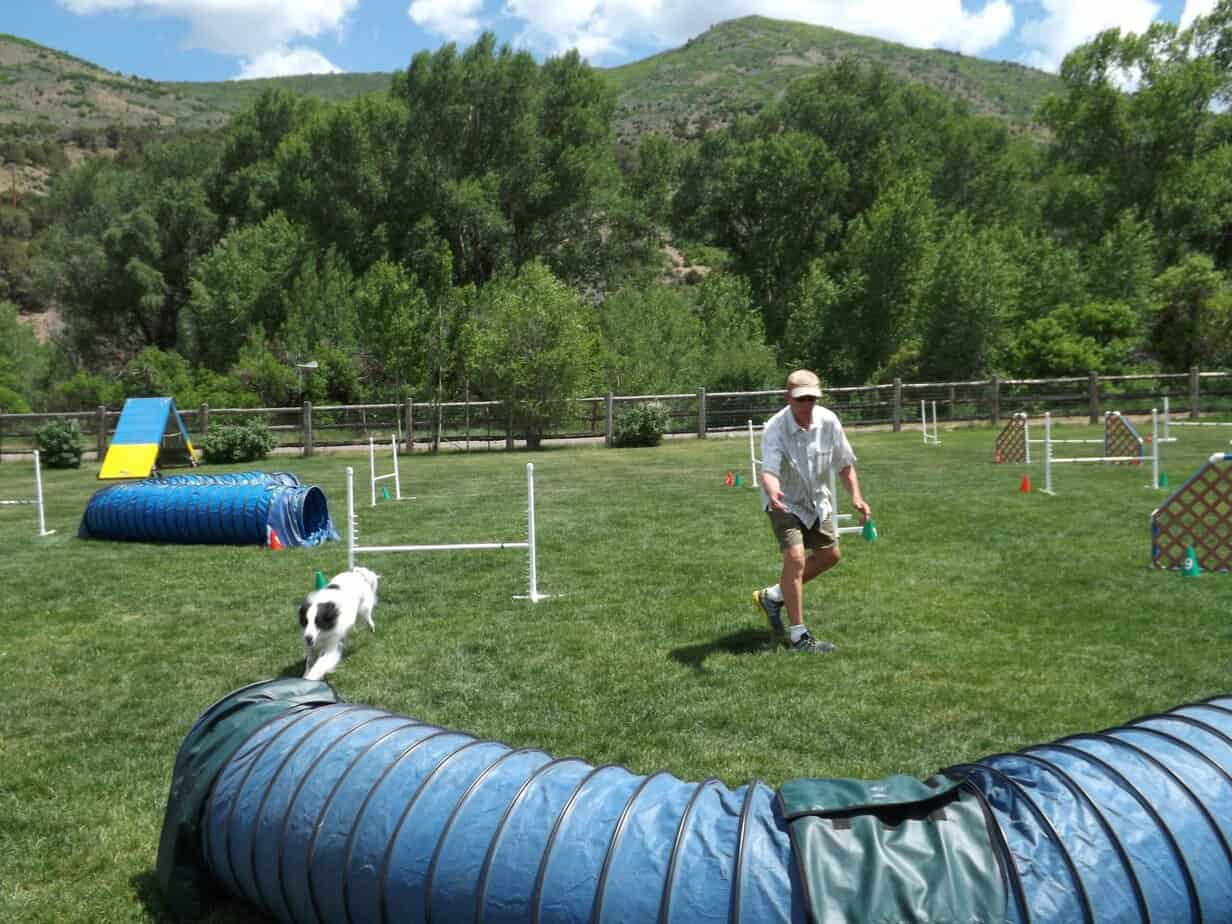
When you are planning your handling path on a course with a distance challenge, it’s important to maintain a few feet between you and the line. If your dog can perform the challenge from 10 feet, I promise that he can perform it from 12 or 14 feet as well. Giving yourself a little extra room can help you in several ways.
Agility Course Designs With “Line Traps”
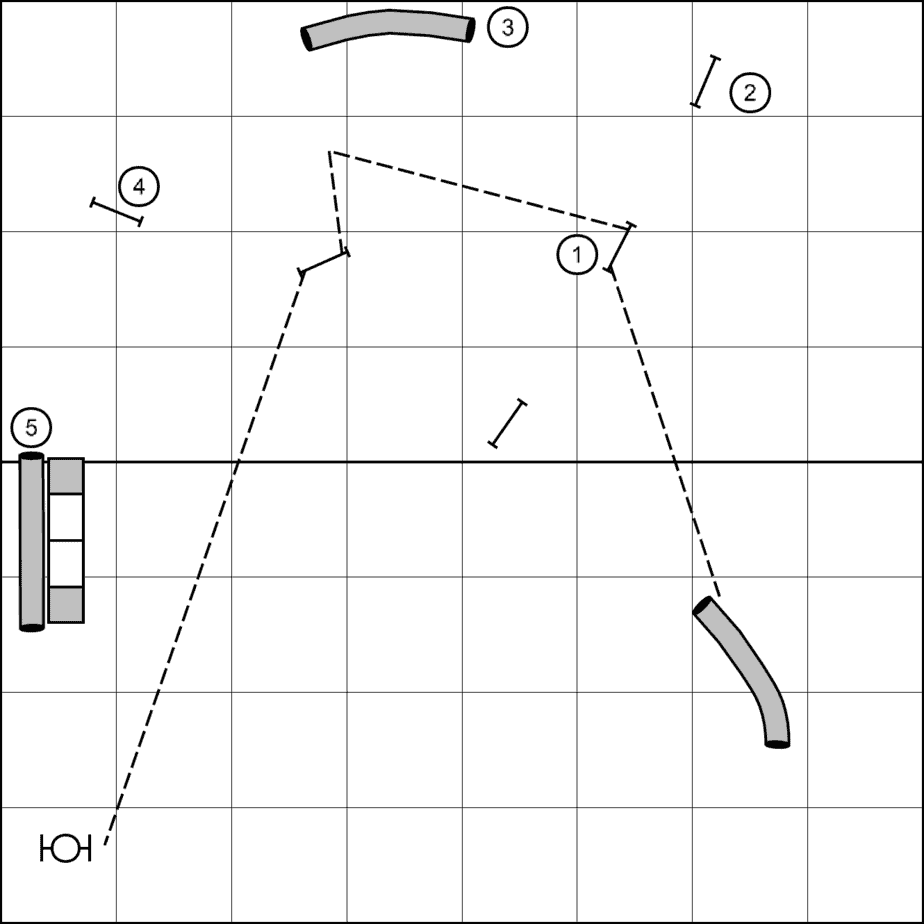
Some courses are designed “trap” people who are running right on the line. The course shown is a good example. If you take advantage of the closest point to jump #4, the action of moving around the jump that is on the line pulls your dog toward the off-course A-Frame rather than the tunnel. Staying out of that pocket gives you a much better chance of using your motion to push to the outside #5 tunnel.
Saving Room for Motion Cues
Sometimes agility runs just don’t go as planned, and your dog gets stalled out or starts coming toward you instead of moving away to the correct obstacle. If you are right next to the line, your only options are to yell verbal cues at your dog or wave frantically with your arms to try to get him to move away. However, if your planned path kept you a few feet away from the line, you have room to step toward your dog’s path and use your motion to give him clearer direction about where to go.
The Dreaded “Line Dance”
One of the things I preach is consistent cues with no extra motions or unrelated body language. Getting too close to the line can cause handlers to lose track of their position or overbalance, resulting an a lot of flailing about and gyrating to avoid stepping on the line. All of that extra (com)motion is confusing to your dog and doesn’t help him stay on course. Line dancing should only be done in C&W bars.
Today’s Dog Agility Trialing Tip
When you are walking a course with a distance challenge, make sure you are planning a path that keeps you at least a few feet away from the line. Doing so will make sure you don’t get stuck in a trap, you have room to move if you need it, and you will avoid the funny but unproductive line dance.
In Three Ways to Regain Distance From the Line in Dog Agility, I talk about how to regain distance from the line if you happen to venture too close.
You Might Also Like…
The Complete Guide to Dog Agility Distance Handling
Dog agility distance handling isn’t magic — it’s a skill any team can build. This complete guide covers the 5 essential skills, the 6 Cs framework, how to train distance, and the most common mistakes to avoid.
Dog Agility Distance Training – What is the CLAWS Framework?
Independent obstacle performance is the foundation of dog agility distance training. Learn what CLAWS means and how this simple framework can transform your distance work.
5 Ways to Reward Your Agility Dog for Distance Training
If your agility dog keeps running back to you mid-run, reward placement may be the issue. Here are 5 ways to reward your agility dog for distance that actually work.
Get tips, stories, discounts, and early notification of events and new courses delivered straight to your inbox! Join the community!
Second and Third Photos: Courtesy of Lakeside Studios